Gender equality

Thumbnail

Women represent both half of the world's population – and half the world's economic potential. Their participation in the labour market reduces poverty because they often invest 90 per cent of their income in the well-being, education and nutrition of their families. Yet labour force participation by women has stagnated at about 55 per cent globally since 2010. Moreover, women are disproportionately represented in precarious work – low-paid, low-skilled and insecure jobs.

Training plays an important role in the pursuit of equality of opportunity and treatment for women and men in the world of work. Yet women often lack access to technical and vocational education and training. Many also lack the basic functional skills, such as literacy and numeracy, to participate meaningfully in the work force. Overcoming this challenge requires the adoption of a life-cycle approach. This includes improving girls’ access to basic education; overcoming logistic, economic and cultural barriers to apprenticeships and to secondary and vocational training for young women; and meeting the training needs of women re-entering the labour market and of older women who have not had equal access to opportunities for lifelong learning.

Identifier
skpGenEqul
Slug
gender-equality

Revealing Potential: Career Guidance Boosting Albanian Youth Employability

Revealing Potential: Career Guidance Boosting Albanian Youth Employability

Kind:
Event
Start Date:
25 Nov 2025
End Date:
04 Jun 2026
Event Location:
Online
EventType:
Language:

English

Slug
english
Identifier
skpEng
Language Version:
--
Sources:

Think tanks, foundations and consultancy services

The platform also contains information and resources developed by Think tanks, foundations and consultancy services.

Thumbnail
Identifier
skpttfcs
Slug
think-tanks-foundations-and-consultancy-services
Topics:

Career guidance and employment services

Thumbnail

Career guidance and counselling, career education and lifelong development of skills for employability are key for success in learning activities, effective career transitions, livelihood planning, entrepreneurship and in increasing labour market participation. They are instrumental in promoting skills utilization, recognition (RPL), as well as in improving enterprise human resource management.

Career development activities encompass a wide variety of support activities including career information and advice, counselling, work exposure (e.g. job shadowing, work experience periods), assessment, coaching, mentoring, professional networking, advocacy, basic and employability skills training (curricular and non-curricular) and entrepreneurship training. It is often an area which is fragmented across different ministries (e.g. education, TVET, employment, youth) requiring an effort to achieve the necessary coordination to provide adequate support to individuals during learning, employment and unemployment/inactivity periods.
 

Identifier
skpLMIES
Slug
career-guidance-and-employment-services

Gender equality

Thumbnail

Women represent both half of the world's population – and half the world's economic potential. Their participation in the labour market reduces poverty because they often invest 90 per cent of their income in the well-being, education and nutrition of their families. Yet labour force participation by women has stagnated at about 55 per cent globally since 2010. Moreover, women are disproportionately represented in precarious work – low-paid, low-skilled and insecure jobs.

Training plays an important role in the pursuit of equality of opportunity and treatment for women and men in the world of work. Yet women often lack access to technical and vocational education and training. Many also lack the basic functional skills, such as literacy and numeracy, to participate meaningfully in the work force. Overcoming this challenge requires the adoption of a life-cycle approach. This includes improving girls’ access to basic education; overcoming logistic, economic and cultural barriers to apprenticeships and to secondary and vocational training for young women; and meeting the training needs of women re-entering the labour market and of older women who have not had equal access to opportunities for lifelong learning.

Identifier
skpGenEqul
Slug
gender-equality

Lifelong learning

Thumbnail

There is a critical need for a greater overall investment in education and training, particularly in developing countries. Education and training investments should be closely linked to economic and employment growth strategies and programmes. Responsibility should be shared between the government (primary responsibility), enterprises, the social partners, and the individual. To make lifelong learning for all a reality, countries will need to make major reforms of their vocational and education and training systems. School-to-work schemes for young people should integrate education with workplace learning. Training systems need to become more flexible and responsive to rapidly changing skill requirements. Reforms should also focus on how learning can be facilitated, not just on training for specific occupational categories.

Identifier
skpPSLLL
Slug
lifelong-learning

Youth employability

Thumbnail

Globally, nearly 68 million young women and men are looking for and available for work,  and an estimated 123 million young people are working but living in poverty. The number who are not in employment, education or training (NEET) stands at 267 million, a majority of whom are young women. Significantly, young people are three times as likely as adults (25 years and older) to be unemployed.

Skills development is a primary means of enabling young people to make a smooth transition to work. A comprehensive approach is required to integrate young women and men in the labour market, including relevant and quality skills training, labour market information, career guidance and employment services, recognition of prior learning, incorporating entrepreneurship with training and effective skills forecasting. Improved basic education and core work skills are particularly important to enable youth to engage in lifelong learning as well as transition to the labour market. 

Identifier
skpYoEmp
Slug
youth-employability
Knowledge Products:

Career Guidance has been one of the core areas of intervention under the RisiAlbania project, funded by SDC and implemented by Helvetas. RisiAlbania designed and adopted a holistic approach to activate and support all the necessary market system pillars in career guidance: institutional and organizational capacities of providers, development of content, and development of career counsellors.
In this dedicated session,  Edlira Muedini and Ermira Shyti from Helvetas Albania will present key insights, approaches, and lessons learned.

Time: 25 November 2025 at 13.30 - 14.45

Place: Online in Teams

More information: https://www.risialbania.al/media/6847da2b1d646.pdf


Subject Tags:
Regions:
Countries and territories:
Economic groups:
--

Introducing the Revised IAEVG Ethical Guidelines

Introducing the Revised IAEVG Ethical Guidelines

Kind:
Event
Start Date:
11 Nov 2025
End Date:
04 Jun 2026
Event Location:
Online
EventType:
Language:

English

Slug
english
Identifier
skpEng
Language Version:
--
Sources:

Other sources

Experts from many international, regional and national agencies generously share their views, experiences and findings on skills, helping policy-makers among other stakeholders to understand the linkages between education, training and the world of work, and how to integrate skills into national development planning to promote employment and economic growth.

Thumbnail
Identifier
skpOSource
Slug
other-sources
Topics:

Access to training

Thumbnail

Access for all to good quality education, vocational training and workplace learning is a fundamental principle of social cohesion and economic growth. Some groups of people may require targeted attention if they are to benefit from education, training and employment opportunities.  

This is particularly the case for disadvantaged youth, lower skilled workers, people with disabilities, and people in rural communities. The attractiveness of vocational education and training is enhanced when combined with entrepreneurship training and when public policies encourage utilization of higher skills by business. 
 

Identifier
skpATSU
Slug
access-to-training

Career guidance and employment services

Thumbnail

Career guidance and counselling, career education and lifelong development of skills for employability are key for success in learning activities, effective career transitions, livelihood planning, entrepreneurship and in increasing labour market participation. They are instrumental in promoting skills utilization, recognition (RPL), as well as in improving enterprise human resource management.

Career development activities encompass a wide variety of support activities including career information and advice, counselling, work exposure (e.g. job shadowing, work experience periods), assessment, coaching, mentoring, professional networking, advocacy, basic and employability skills training (curricular and non-curricular) and entrepreneurship training. It is often an area which is fragmented across different ministries (e.g. education, TVET, employment, youth) requiring an effort to achieve the necessary coordination to provide adequate support to individuals during learning, employment and unemployment/inactivity periods.
 

Identifier
skpLMIES
Slug
career-guidance-and-employment-services

Gender equality

Thumbnail

Women represent both half of the world's population – and half the world's economic potential. Their participation in the labour market reduces poverty because they often invest 90 per cent of their income in the well-being, education and nutrition of their families. Yet labour force participation by women has stagnated at about 55 per cent globally since 2010. Moreover, women are disproportionately represented in precarious work – low-paid, low-skilled and insecure jobs.

Training plays an important role in the pursuit of equality of opportunity and treatment for women and men in the world of work. Yet women often lack access to technical and vocational education and training. Many also lack the basic functional skills, such as literacy and numeracy, to participate meaningfully in the work force. Overcoming this challenge requires the adoption of a life-cycle approach. This includes improving girls’ access to basic education; overcoming logistic, economic and cultural barriers to apprenticeships and to secondary and vocational training for young women; and meeting the training needs of women re-entering the labour market and of older women who have not had equal access to opportunities for lifelong learning.

Identifier
skpGenEqul
Slug
gender-equality

Lifelong learning

Thumbnail

There is a critical need for a greater overall investment in education and training, particularly in developing countries. Education and training investments should be closely linked to economic and employment growth strategies and programmes. Responsibility should be shared between the government (primary responsibility), enterprises, the social partners, and the individual. To make lifelong learning for all a reality, countries will need to make major reforms of their vocational and education and training systems. School-to-work schemes for young people should integrate education with workplace learning. Training systems need to become more flexible and responsive to rapidly changing skill requirements. Reforms should also focus on how learning can be facilitated, not just on training for specific occupational categories.

Identifier
skpPSLLL
Slug
lifelong-learning

Migrant workers

Thumbnail

According to the ILO global estimates on migrant workers, there were around 164 million migrant workers in 2017. 

Migrant workers contribute to growth and development in their countries of destination, while countries of origin greatly benefit from their remittances and the skills acquired during their migration experience. Yet, many migrant workers face challenges in accessing quality training and decent jobs including under-utilization of skills, a lack of employment or training opportunities, lack of information, and exploitation of low-skilled workers.

To address these challenges, countries need to strengthen skills anticipation systems to inform migration policies, increase access to education and training, and establish bilateral or multilateral recognition of qualifications and skills.

Identifier
skpMigWor
Slug
migrant-workers

Older workers

Thumbnail

Access for all to good quality education, vocational training and workplace learning is a fundamental principle of social cohesion and economic growth. Some groups of people may require targeted attention if they are to benefit from education, training and employment opportunities.

This is particularly the case for disadvantaged youth, lower skilled workers, people with disabilities, and people in rural communities. The attractiveness of vocational education and training is enhanced when combined with entrepreneurship training and when public policies encourage utilization of higher skills by business.

Identifier
skpOldwor
Slug
older-workers

People with disabilities

Thumbnail

Of an estimated 1 billion people with disabilities in the world today, some 785 million are of working age. While many are successfully employed and fully integrated into society, most face a disproportionate level of poverty and unemployment. This is a massive loss both to them and their countries. A strategy of including people with disabilities in training and employment promotion policies, combined with targeted supports to ensure their participation, can help disabled persons obtain productive mainstream employment.

Identifier
skpPeoDis
Slug
people-with-disabilities

Teachers, trainers and training organizations

Thumbnail

At the heart of any skills system are the managers and staff of training institutions who face considerable challenges to deliver quality programmes at a time of fiscal constraint. As the expectations placed on institutions continue to grow, managers and trainers are increasingly expected to deliver flexible, responsive and current programmes based on strong partnerships with local employers that provide good employment outcomes. Because of this, there is a need for constituents to build the capacity of their institutional workforce to meet the expectations placed upon them by demand driven systems.

Identifier
skpTeach
Slug
teachers-trainers-and-training-organizations

Training quality and relevance

Thumbnail
Identifier
skpTrainQR
Slug
training-quality-and-relevance
Knowledge Products:

Ethics lie at the core of quality practice in educational, vocational and career guidance. The International Association for Educational and Vocational Guidance (IAEVG) invites you to this Global Careers Month webinar, introducing the revised IAEVG Ethical Guidelines.

This session will explore:
*The importance of ethics in educational, vocational and career guidance
*The key revisions to the IAEVG Ethical Guidelines and the rationale behind them;
*Ways the Guidelines can be applied across varied cultural and professional settings

Speakers include:
*Jaana Kettunen, IAEVG President 
*Mary McMahon, University of Queensland, IAEVG Board member
*Nancy Arthur, University of South Australia
*Maximus Sefotho, University of Johannesburg, South Africa
*Jennifer McKenzie, McKenzie Guidance Solutions, Ireland

Time: 11 November 2025 at 12:00-13:00 (CET)

Place: Online (please register at https://tinyurl.com/IAEVGEthics)

More information: https://tinyurl.com/IAEVGEthics

Subject Tags:
Regions:
Countries and territories:
Economic groups:
--

Haustráðstefna FNS 2025 - Virðing og velferð

Haustráðstefna FNS 2025 - Virðing og velferð

Kind:
Event
Start Date:
07 Nov 2025
End Date:
04 Jun 2026
Event Location:
Reykjavík, Iceland
EventType:
Language:

Icelandic

Slug
icelandic
Identifier
skpise
Language Version:
--
Sources:

Other sources

Experts from many international, regional and national agencies generously share their views, experiences and findings on skills, helping policy-makers among other stakeholders to understand the linkages between education, training and the world of work, and how to integrate skills into national development planning to promote employment and economic growth.

Thumbnail
Identifier
skpOSource
Slug
other-sources
Topics:

Gender equality

Thumbnail

Women represent both half of the world's population – and half the world's economic potential. Their participation in the labour market reduces poverty because they often invest 90 per cent of their income in the well-being, education and nutrition of their families. Yet labour force participation by women has stagnated at about 55 per cent globally since 2010. Moreover, women are disproportionately represented in precarious work – low-paid, low-skilled and insecure jobs.

Training plays an important role in the pursuit of equality of opportunity and treatment for women and men in the world of work. Yet women often lack access to technical and vocational education and training. Many also lack the basic functional skills, such as literacy and numeracy, to participate meaningfully in the work force. Overcoming this challenge requires the adoption of a life-cycle approach. This includes improving girls’ access to basic education; overcoming logistic, economic and cultural barriers to apprenticeships and to secondary and vocational training for young women; and meeting the training needs of women re-entering the labour market and of older women who have not had equal access to opportunities for lifelong learning.

Identifier
skpGenEqul
Slug
gender-equality

Lifelong learning

Thumbnail

There is a critical need for a greater overall investment in education and training, particularly in developing countries. Education and training investments should be closely linked to economic and employment growth strategies and programmes. Responsibility should be shared between the government (primary responsibility), enterprises, the social partners, and the individual. To make lifelong learning for all a reality, countries will need to make major reforms of their vocational and education and training systems. School-to-work schemes for young people should integrate education with workplace learning. Training systems need to become more flexible and responsive to rapidly changing skill requirements. Reforms should also focus on how learning can be facilitated, not just on training for specific occupational categories.

Identifier
skpPSLLL
Slug
lifelong-learning

Migrant workers

Thumbnail

According to the ILO global estimates on migrant workers, there were around 164 million migrant workers in 2017. 

Migrant workers contribute to growth and development in their countries of destination, while countries of origin greatly benefit from their remittances and the skills acquired during their migration experience. Yet, many migrant workers face challenges in accessing quality training and decent jobs including under-utilization of skills, a lack of employment or training opportunities, lack of information, and exploitation of low-skilled workers.

To address these challenges, countries need to strengthen skills anticipation systems to inform migration policies, increase access to education and training, and establish bilateral or multilateral recognition of qualifications and skills.

Identifier
skpMigWor
Slug
migrant-workers

People with disabilities

Thumbnail

Of an estimated 1 billion people with disabilities in the world today, some 785 million are of working age. While many are successfully employed and fully integrated into society, most face a disproportionate level of poverty and unemployment. This is a massive loss both to them and their countries. A strategy of including people with disabilities in training and employment promotion policies, combined with targeted supports to ensure their participation, can help disabled persons obtain productive mainstream employment.

Identifier
skpPeoDis
Slug
people-with-disabilities
Knowledge Products:

Conference of the Icelandic Association of career and guidance counsellors

The roster includes a lecture regarding inclusion and diversity. The association of queer people in Iceland (samtökin '78) will talk about currents in society and how career and guidance counsellors can add their strenghts to queer youth. There will also be a lecture and workshop regarding bullying and the importance of inclusion, positivity and healthy discussion in our society.

Time: 7 November 2025 at 09:00-15:30 (UCT+00)

Place: Grand Hótel. Sigtún 28, 105 Reykjavík, Iceland

More information: https://fns.is/greinar/dagskra-haustradstefnu-fns-7-november/


Subject Tags:
Regions:
Countries and territories:
Economic groups:
--

A Joint Webinar in Celebration of Global Careers Month 2025 (regional)

A Joint Webinar in Celebration of Global Careers Month 2025 (regional)

Kind:
Event
Start Date:
13 Nov 2025
End Date:
04 Jun 2026
Event Location:
Online
EventType:
Language:

Japanese

Slug
japanese
Identifier
skpja
Language Version:
--
Sources:

Other sources

Experts from many international, regional and national agencies generously share their views, experiences and findings on skills, helping policy-makers among other stakeholders to understand the linkages between education, training and the world of work, and how to integrate skills into national development planning to promote employment and economic growth.

Thumbnail
Identifier
skpOSource
Slug
other-sources
Topics:

Gender equality

Thumbnail

Women represent both half of the world's population – and half the world's economic potential. Their participation in the labour market reduces poverty because they often invest 90 per cent of their income in the well-being, education and nutrition of their families. Yet labour force participation by women has stagnated at about 55 per cent globally since 2010. Moreover, women are disproportionately represented in precarious work – low-paid, low-skilled and insecure jobs.

Training plays an important role in the pursuit of equality of opportunity and treatment for women and men in the world of work. Yet women often lack access to technical and vocational education and training. Many also lack the basic functional skills, such as literacy and numeracy, to participate meaningfully in the work force. Overcoming this challenge requires the adoption of a life-cycle approach. This includes improving girls’ access to basic education; overcoming logistic, economic and cultural barriers to apprenticeships and to secondary and vocational training for young women; and meeting the training needs of women re-entering the labour market and of older women who have not had equal access to opportunities for lifelong learning.

Identifier
skpGenEqul
Slug
gender-equality

Work-based learning and skills utilization

Thumbnail

Increasingly, countries around the world, at all levels of development are putting work-based learning, particularly apprenticeships, high on their policy agenda, recognizing its potential for reducing skills mismatch, meeting skills demand of a fast changing labour market, providing cost-effective training, promoting private sector development and smoothing transitions to the world of work. 

Moreover, the issue of how skills are used in the workplace and how businesses engage with the local skills ecosystem are getting greater attention. It is increasingly recognized that workers who better use their skills are more likely to have greater job satisfaction, earn better wages and are more prepared to adapt to changes in the nature of work, while employers benefit from a more productive and innovative workforce, enabling them to maximise business performance and profitability. 

Identifier
skpWrkLrn
Slug
work-based-learning-and-skills-utilization
Knowledge Products:

This event, jointly organized by the Future Oriented Youth Society (FYouth) of Korea and the Japanese Society for the Studies for Career Education (JSSCE), aims to foster an exchange of ideas on common career guidance themes through research and practical reports. Serving as a starting point for future collaboration, this event marks the beginning of our efforts to establish continuous academic exchange. Japan and Korea share many challenges in the school-to-work transition for young people, and with the recent increase in human mobility between the nations, this partnership will enhance the universality and applicability of our research.

The specific details of the event are as follows, although the title is provisional.
Title: A Joint Webinar in Celebration of Global Careers Month 2025
Date: Between November 10-21, 2025
Format: Webinar
Session 1: Nov 13 (Tue), 19:00-19:40 (JST/KST) - Speaker: Atsushi OKABE (Work-based Learning and Use of Technology)
Session 2: Nov 14 (Fri), 14:00-14:40 (JST/KST) - Speaker: Minwook LEE (Work-based Learning and Use of Technology)
Session 3: Nov 20 (Thu), 19:00-19:40 (JST/KST) - Speaker: Shintaro TAKANO (Gender Equality in Career Development)
Session 4: Nov 21 (Fri), 11:00-11:40 (JST/KST) - Speaker: In-Hyuk LEE (Work-based Learning and Use of Technology)

Languages: Japanese, Korean and English

More information: http://www.f-youth.or.kr/html/sub01.asp and https://jssce.jp/committee/iaevg/

Subject Tags:
Regions:
Countries and territories:
Economic groups:
--

Women and Jobs in Africa Policy Research Workshop

Women and Jobs in Africa Policy Research Workshop

Kind:
Event
Start Date:
11 Nov 2025
End Date:
04 Jun 2026
Event Location:
Accra, Ghana
EventType:
Language:

English

Slug
english
Identifier
skpEng
Language Version:
--
Sources:

Academic institutions

Research papers, synthesis reports, country and programme studies are collected from many academic institutions and national, regional and international professional associations.

Thumbnail
Identifier
skpAcaInst
Slug
academic-institutions

Information is gathered from other international organizations that promote skills development and the transition from education and training to work. The Interagency Group on Technical and Vocational Education and Training (IAG-TVET) was established in 2009 to share research findings, coordinate joint research endeavours, and improve collaboration among organizations working at the international and national levels.

Thumbnail
Identifier
skpIntOrg
Slug
international-organizations

Think tanks, foundations and consultancy services

The platform also contains information and resources developed by Think tanks, foundations and consultancy services.

Thumbnail
Identifier
skpttfcs
Slug
think-tanks-foundations-and-consultancy-services
Topics:

Gender equality

Thumbnail

Women represent both half of the world's population – and half the world's economic potential. Their participation in the labour market reduces poverty because they often invest 90 per cent of their income in the well-being, education and nutrition of their families. Yet labour force participation by women has stagnated at about 55 per cent globally since 2010. Moreover, women are disproportionately represented in precarious work – low-paid, low-skilled and insecure jobs.

Training plays an important role in the pursuit of equality of opportunity and treatment for women and men in the world of work. Yet women often lack access to technical and vocational education and training. Many also lack the basic functional skills, such as literacy and numeracy, to participate meaningfully in the work force. Overcoming this challenge requires the adoption of a life-cycle approach. This includes improving girls’ access to basic education; overcoming logistic, economic and cultural barriers to apprenticeships and to secondary and vocational training for young women; and meeting the training needs of women re-entering the labour market and of older women who have not had equal access to opportunities for lifelong learning.

Identifier
skpGenEqul
Slug
gender-equality

Governance and coordination mechanisms

Thumbnail

Effective governance and coordination are key elements of successful skill systems. Whilst coordination is an important factor, it needs to operate alongside other key conditions to strengthen governance. When multi-level governance is supported by effective communication, sustainable financing and effective coordination, it has the best chance of supporting the establishment of a lifelong learning ecosystem that enables individuals and enterprises to more effectively navigate the world of work and learning.

Identifier
skpGovern
Slug
governance-and-coordination-mechanisms

Recognition and portability of skills

Thumbnail

Skills development can be viewed from a life-cycle perspective of building, maintaining and improving competencies and skills. A holistic approach to skills development encompasses the following features: access to good basic education; development of cognitive and core skills, including literacy, numeracy, communication, problem-solving and learning ability; and, availability of continuous training opportunities targeting adult and older workers.  Systems to improve recognition of attained skills across occupations, industries and countries improve the employability of workers, reduce labour shortages, and promote good working conditions for migrant workers. 

Identifier
skpRAPS
Slug
recognition-and-portability-of-skills
Knowledge Products:

This engaging workshop will unite leading researchers and influential policymakers to explore the dynamic landscape around women and jobs, from labor force participation, skills development, to entrepreneurship and resilient rural livelihoods in Africa.

Topics of interest include jobs for women as related to (but are not limited to):

   Innovations to facilitate labor force participation
   Education and skills development towards better job outcomes
   Gaps in wages between men and women, and occupational segregation
   How social norms affect jobs
   Care economy and care work
   Legal and policy frameworks to facilitate productive work
   The impact of digitization and AI on employment outcomes
   Livelihoods and resilience in agriculture
   Access to markets for SME entrepreneurs

Time: 11-12 November 2025 at 07:00 AM - 04:00 PM ET

Place: the University of Ghana-Legon, Accra, Ghana

More information: https://www.worldbank.org/en/events/2025/11/11/women-and-jobs-in-africa-policy-research-workshop

Subject Tags:
Regions:

Africa

Region Image
Countries and territories:
Economic groups:
--

Industry week / La Semaine de l'industrie

Industry week / La Semaine de l'industrie

Kind:
Event
Start Date:
19 Nov 2025
End Date:
04 Jun 2026
Event Location:
Various locations throughout France and overseas
Language:

French

Slug
french
Identifier
skpFrn
Language Version:
--
Sources:

Governments

Governments hold a wealth of knowledge on skills development, and are increasingly realizing the value of learning from each others’ experiences. Their policy documents, programme evaluations, and research findings contain their experience and ideas on how to better link skills to employment

Thumbnail
Identifier
skpGov
Slug
governments
Topics:

Career guidance and employment services

Thumbnail

Career guidance and counselling, career education and lifelong development of skills for employability are key for success in learning activities, effective career transitions, livelihood planning, entrepreneurship and in increasing labour market participation. They are instrumental in promoting skills utilization, recognition (RPL), as well as in improving enterprise human resource management.

Career development activities encompass a wide variety of support activities including career information and advice, counselling, work exposure (e.g. job shadowing, work experience periods), assessment, coaching, mentoring, professional networking, advocacy, basic and employability skills training (curricular and non-curricular) and entrepreneurship training. It is often an area which is fragmented across different ministries (e.g. education, TVET, employment, youth) requiring an effort to achieve the necessary coordination to provide adequate support to individuals during learning, employment and unemployment/inactivity periods.
 

Identifier
skpLMIES
Slug
career-guidance-and-employment-services

Digital skills

Thumbnail

The world of work is undergoing a substantial transformation due to new forces. In particular, technological advances, such as AI, automation and robotics, have produced numerous new opportunities, but also given rise to urgent challenges. While new jobs are constantly being created with the emergence of the digital economy, many jobs are at risk of becoming obsolete. Digital innovations will rapidly change the demand for skills, thereby creating a wider skills gap that has the potential to hold back economic growth. Equipping people with basic or advanced digital skills promises to prepare them for unprecedented job opportunities in the digital economy. This will lead to innovation, higher productivity and competitiveness, as well as expanding markets, access to work and entrepreneurship opportunities. 

Identifier
skpdigskills
Slug
digital-skills

Gender equality

Thumbnail

Women represent both half of the world's population – and half the world's economic potential. Their participation in the labour market reduces poverty because they often invest 90 per cent of their income in the well-being, education and nutrition of their families. Yet labour force participation by women has stagnated at about 55 per cent globally since 2010. Moreover, women are disproportionately represented in precarious work – low-paid, low-skilled and insecure jobs.

Training plays an important role in the pursuit of equality of opportunity and treatment for women and men in the world of work. Yet women often lack access to technical and vocational education and training. Many also lack the basic functional skills, such as literacy and numeracy, to participate meaningfully in the work force. Overcoming this challenge requires the adoption of a life-cycle approach. This includes improving girls’ access to basic education; overcoming logistic, economic and cultural barriers to apprenticeships and to secondary and vocational training for young women; and meeting the training needs of women re-entering the labour market and of older women who have not had equal access to opportunities for lifelong learning.

Identifier
skpGenEqul
Slug
gender-equality

Participation of employers' and workers' organizations

Thumbnail

The world of learning and the world of work are separate but linked. While one involves learning, the other produces goods and services. Neither can thrive without the other. Strong partnerships between government, employers and workers help ensure the relevance of training to the changing needs of enterprises and labour markets. 

Identifier
skpPSP
Slug
participation-of-employers-and-workers-organizations

Youth employability

Thumbnail

Globally, nearly 68 million young women and men are looking for and available for work,  and an estimated 123 million young people are working but living in poverty. The number who are not in employment, education or training (NEET) stands at 267 million, a majority of whom are young women. Significantly, young people are three times as likely as adults (25 years and older) to be unemployed.

Skills development is a primary means of enabling young people to make a smooth transition to work. A comprehensive approach is required to integrate young women and men in the labour market, including relevant and quality skills training, labour market information, career guidance and employment services, recognition of prior learning, incorporating entrepreneurship with training and effective skills forecasting. Improved basic education and core work skills are particularly important to enable youth to engage in lifelong learning as well as transition to the labour market. 

Identifier
skpYoEmp
Slug
youth-employability
Knowledge Products:

Industry Week (La Semaine de l'industrie) promotes industry and its players by offering educational events and opportunities to discover different professions: company visits, job dating, career forums, web conferences, classroom presentations, exhibitions, etc. Every year, this major national event helps to boost the sector's appeal. It also promotes gender diversity in the workplace and the role of women in different industries.

Time: 19-23 November 2025

Locations: See the event website for location details

More information: https://www.entreprises.gouv.fr/semaine-de-lindustrie

Subject Tags:
Regions:
Countries and territories:
Economic groups:
--

Simposio Educación para la Carrera y Orientación Profesional en Latinoamérica 2025 (regional)

Simposio Educación para la Carrera y Orientación Profesional en Latinoamérica 2025 (regional)

Kind:
Event
Start Date:
12 Nov 2025
End Date:
04 Jun 2026
Event Location:
Online
EventType:
Language:

Spanish

Slug
spanish
Identifier
skpEsp
Language Version:
--
Sources:

Academic institutions

Research papers, synthesis reports, country and programme studies are collected from many academic institutions and national, regional and international professional associations.

Thumbnail
Identifier
skpAcaInst
Slug
academic-institutions

Other sources

Experts from many international, regional and national agencies generously share their views, experiences and findings on skills, helping policy-makers among other stakeholders to understand the linkages between education, training and the world of work, and how to integrate skills into national development planning to promote employment and economic growth.

Thumbnail
Identifier
skpOSource
Slug
other-sources
Topics:

Anticipating and matching skills needs

Thumbnail

Anticipating and building skills for the future is essential to a rapidly changing labour market. This applies to changes in the types and levels of skills needed as well as in occupational and technical areas. Effective methods to anticipate future skills needs and avoid potential mismatches include: sustained dialogue between employers and trainers, coordination across government institutions, labour market information systems, employment services and performance reviews of training institutions. 

Identifier
skpAFSN
Slug
anticipating-and-matching-skills-needs

Gender equality

Thumbnail

Women represent both half of the world's population – and half the world's economic potential. Their participation in the labour market reduces poverty because they often invest 90 per cent of their income in the well-being, education and nutrition of their families. Yet labour force participation by women has stagnated at about 55 per cent globally since 2010. Moreover, women are disproportionately represented in precarious work – low-paid, low-skilled and insecure jobs.

Training plays an important role in the pursuit of equality of opportunity and treatment for women and men in the world of work. Yet women often lack access to technical and vocational education and training. Many also lack the basic functional skills, such as literacy and numeracy, to participate meaningfully in the work force. Overcoming this challenge requires the adoption of a life-cycle approach. This includes improving girls’ access to basic education; overcoming logistic, economic and cultural barriers to apprenticeships and to secondary and vocational training for young women; and meeting the training needs of women re-entering the labour market and of older women who have not had equal access to opportunities for lifelong learning.

Identifier
skpGenEqul
Slug
gender-equality

Skills policies and strategies

Thumbnail

Skills and employment policies should be viewed together.  The full value of one policy set is realized when it supports the objectives of the other.  For investments in education and training to yield maximum benefit to workers, enterprises, and economies, countries’ capacities for coordination is critical in three areas: connecting basic education to technical training and then to market entry; ensuring continuous communication between employers and training providers so that training meets the needs and aspirations of workers and enterprises, and integrating skills development policies with industrial, investment, trade, technology, environmental, rural and local development policies.

Identifier
skpPolConv
Slug
skills-policies-and-strategies

Training quality and relevance

Thumbnail
Identifier
skpTrainQR
Slug
training-quality-and-relevance
Knowledge Products:

El Simposio está diseñado como un punto de encuentro para impulsar la preparación para el trabajo en clave latinoamericana y enfoque interseccional, focalizándose en: 1) la pertinencia cultural de las prácticas de educación para la carrera y la orientación profesional; y 2) la formación de profesionales de la orientación a lo largo de la vida.
Este enfoque crítico y de vanguardia impulsa la innovación en los servicios de orientación profesional y la difusión de investigación avanzada. Para ello, ya contamos con la participación confirmada de Marcelo Afonso Ribeiro (Brasil), Sergio Rascován (Argentina), Gabriela Cabrera (Colombia) y Gonzalo Gallardo (Chile) entre otras destacadas figuras, con quienes esperamos enriquecer la reflexión académica sobre estas materias.

The Symposium is designed as a meeting point to boost work readiness with a Latin American perspective and an intersectional approach, focusing on: 1) the cultural relevance of career education and professional guidance practices; and 2) the lifelong training of guidance professionals.

This critical and cutting-edge approach drives innovation in professional guidance services and the dissemination of advanced research. To this end, we already have confirmed participation from Marcelo Afonso Ribeiro (Brazil), Sergio Rascován (Argentina), Gabriela Cabrera (Colombia), and Gonzalo Gallardo (Chile), among other prominent figures, with whom we hope to enrich the academic reflection on these matters.

Date: 12-13 November 2025

Time: 09:00 hrs (GMT-3)

Location: Online

More information: https://ocides.org/desarrollodecarreralatam

Subject Tags:
Regions:

Americas

Region Image
Countries and territories:
Economic groups:
--

Semana de la Empleabilidad UFRO

Semana de la Empleabilidad UFRO

Kind:
Event
Start Date:
17 Nov 2025
End Date:
04 Jun 2026
Event Location:
Temuco, Chile
Language:

Spanish

Slug
spanish
Identifier
skpEsp
Language Version:
--
Sources:

Academic institutions

Research papers, synthesis reports, country and programme studies are collected from many academic institutions and national, regional and international professional associations.

Thumbnail
Identifier
skpAcaInst
Slug
academic-institutions
Topics:

Anticipating and matching skills needs

Thumbnail

Anticipating and building skills for the future is essential to a rapidly changing labour market. This applies to changes in the types and levels of skills needed as well as in occupational and technical areas. Effective methods to anticipate future skills needs and avoid potential mismatches include: sustained dialogue between employers and trainers, coordination across government institutions, labour market information systems, employment services and performance reviews of training institutions. 

Identifier
skpAFSN
Slug
anticipating-and-matching-skills-needs

Career guidance and employment services

Thumbnail

Career guidance and counselling, career education and lifelong development of skills for employability are key for success in learning activities, effective career transitions, livelihood planning, entrepreneurship and in increasing labour market participation. They are instrumental in promoting skills utilization, recognition (RPL), as well as in improving enterprise human resource management.

Career development activities encompass a wide variety of support activities including career information and advice, counselling, work exposure (e.g. job shadowing, work experience periods), assessment, coaching, mentoring, professional networking, advocacy, basic and employability skills training (curricular and non-curricular) and entrepreneurship training. It is often an area which is fragmented across different ministries (e.g. education, TVET, employment, youth) requiring an effort to achieve the necessary coordination to provide adequate support to individuals during learning, employment and unemployment/inactivity periods.
 

Identifier
skpLMIES
Slug
career-guidance-and-employment-services

Gender equality

Thumbnail

Women represent both half of the world's population – and half the world's economic potential. Their participation in the labour market reduces poverty because they often invest 90 per cent of their income in the well-being, education and nutrition of their families. Yet labour force participation by women has stagnated at about 55 per cent globally since 2010. Moreover, women are disproportionately represented in precarious work – low-paid, low-skilled and insecure jobs.

Training plays an important role in the pursuit of equality of opportunity and treatment for women and men in the world of work. Yet women often lack access to technical and vocational education and training. Many also lack the basic functional skills, such as literacy and numeracy, to participate meaningfully in the work force. Overcoming this challenge requires the adoption of a life-cycle approach. This includes improving girls’ access to basic education; overcoming logistic, economic and cultural barriers to apprenticeships and to secondary and vocational training for young women; and meeting the training needs of women re-entering the labour market and of older women who have not had equal access to opportunities for lifelong learning.

Identifier
skpGenEqul
Slug
gender-equality

Youth employability

Thumbnail

Globally, nearly 68 million young women and men are looking for and available for work,  and an estimated 123 million young people are working but living in poverty. The number who are not in employment, education or training (NEET) stands at 267 million, a majority of whom are young women. Significantly, young people are three times as likely as adults (25 years and older) to be unemployed.

Skills development is a primary means of enabling young people to make a smooth transition to work. A comprehensive approach is required to integrate young women and men in the labour market, including relevant and quality skills training, labour market information, career guidance and employment services, recognition of prior learning, incorporating entrepreneurship with training and effective skills forecasting. Improved basic education and core work skills are particularly important to enable youth to engage in lifelong learning as well as transition to the labour market. 

Identifier
skpYoEmp
Slug
youth-employability
Knowledge Products:

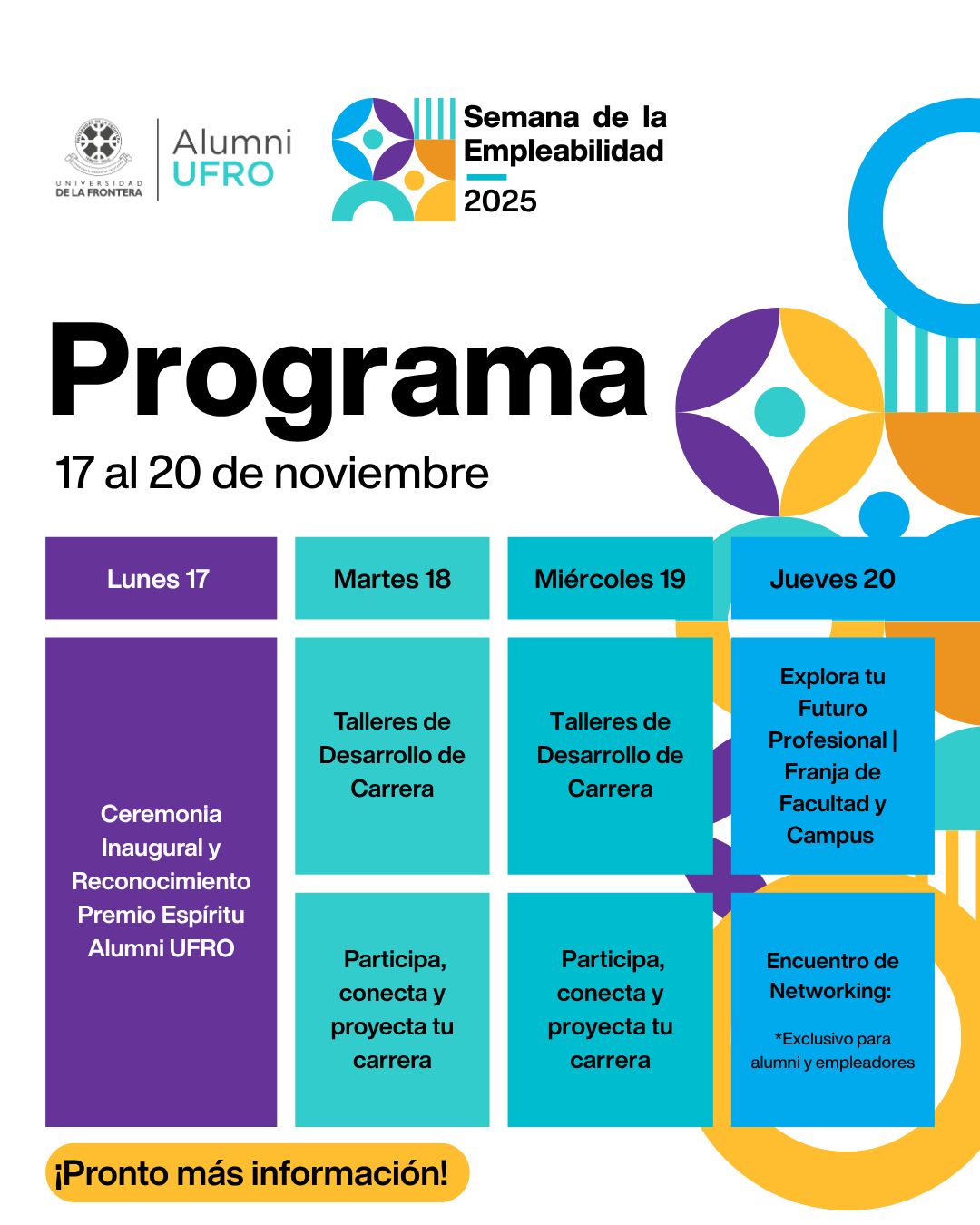
La Semana de la Empleabilidad 2025 de la Universidad de La Frontera (UFRO), a realizarse entre el 17 y 22 de noviembre de 2025, es una instancia estratégica diseñada para conectar el talento de estudiantes y egresados con el entorno laboral. Su objetivo principal es facilitar la visualización de trayectorias destacadas, generar oportunidades de networking con organizaciones públicas y privadas, y fomentar una reflexión crucial sobre las nuevas competencias profesionales que demanda el futuro del trabajo, asegurando que los futuros egresados puedan construir trayectorias laborales exitosas, sostenibles y pertinentes a las necesidades de la sociedad actual. Todo esto, desde el enfoque educativo de desarrollo de carrera, abierto a todo público, con participación de expertos en orientación profesional.

The UFRO 2025 Employability Week (Semana de la Empleabilidad), hosted by the Universidad de La Frontera (UFRO) and taking place from November 17 to 22, 2025, is a strategic event designed to connect the talent of students and graduates with the labor market. Its main goal is to facilitate the visualization of outstanding career paths, generate networking opportunities with public and private organizations, and foster a crucial discussion about the new professional skills demanded by the future of work. This ensures that future graduates can build successful, sustainable, and relevant careers that meet the needs of current society. All of this is viewed through an educational approach focused on career development, open to the general public, and features the participation of professional guidance experts.

*This event has the collaboration of Fundación OCIDES which is a IAEVG member.

Time: 09:00 (GMT-3)

Place: Universidad de la Frontera, Chile

For more information: https://alumni.ufro.cl/

Subject Tags:
Regions:

Americas

Region Image
Countries and territories:
Economic groups:
--

Navigating the Future: Skills and Jobs in the Green and Digital Transitions

Navigating the Future: Skills and Jobs in the Green and Digital Transitions

Type:
Document
Content Type:
Briefing notes
Language:

English

Slug
english
Identifier
skpEng
Sources:

ILO

The International Labour Organization is the tripartite U.N. agency that promotes Decent Work through employment, social security, labour standards and social dialogue. Its work on skills development is guided by the conceptual framework on Skills to improve productivity, employment growth, and development agreed in 2008 by representatives of Governments, Employers’ Associations and Workers’ Associations. Research, policy advice, and pilot projects and technical cooperation programmes to apply good practices in different circumstances across its 185 member States aims to boost the employability of workers, the productivity and competitiveness of enterprises, and the inclusiveness of economic growth. The ILO Secretariat in offices in 40 countries works with Ministries of Labour, employers’ organizations, and trade unions to integrate skills development into national and sector development strategies in order to better meet current labour market needs and to prepare for the jobs of the future; to expand access to employment-related training so that youth, persons with disabilities and other vulnerable groups are better able to acquire skills and secure productive and decent work; and to improve the ability of public employment services to provide career guidance, maintain labour exchange services, and deliver active labour market programmes.For more information regarding the ILO’s work on skills and employability go to: http://www.ilo.org/skills/lang--en/index.htm; for ILO/Cinterfor's Knowledge Management Plarform, see: http://www.oitcinterfor.org

Thumbnail
Identifier
skpILO
Slug
ilo
Topics:

Anticipating and matching skills needs

Thumbnail

Anticipating and building skills for the future is essential to a rapidly changing labour market. This applies to changes in the types and levels of skills needed as well as in occupational and technical areas. Effective methods to anticipate future skills needs and avoid potential mismatches include: sustained dialogue between employers and trainers, coordination across government institutions, labour market information systems, employment services and performance reviews of training institutions. 

Identifier
skpAFSN
Slug
anticipating-and-matching-skills-needs

Digital skills

Thumbnail

The world of work is undergoing a substantial transformation due to new forces. In particular, technological advances, such as AI, automation and robotics, have produced numerous new opportunities, but also given rise to urgent challenges. While new jobs are constantly being created with the emergence of the digital economy, many jobs are at risk of becoming obsolete. Digital innovations will rapidly change the demand for skills, thereby creating a wider skills gap that has the potential to hold back economic growth. Equipping people with basic or advanced digital skills promises to prepare them for unprecedented job opportunities in the digital economy. This will lead to innovation, higher productivity and competitiveness, as well as expanding markets, access to work and entrepreneurship opportunities. 

Identifier
skpdigskills
Slug
digital-skills

Gender equality

Thumbnail

Women represent both half of the world's population – and half the world's economic potential. Their participation in the labour market reduces poverty because they often invest 90 per cent of their income in the well-being, education and nutrition of their families. Yet labour force participation by women has stagnated at about 55 per cent globally since 2010. Moreover, women are disproportionately represented in precarious work – low-paid, low-skilled and insecure jobs.

Training plays an important role in the pursuit of equality of opportunity and treatment for women and men in the world of work. Yet women often lack access to technical and vocational education and training. Many also lack the basic functional skills, such as literacy and numeracy, to participate meaningfully in the work force. Overcoming this challenge requires the adoption of a life-cycle approach. This includes improving girls’ access to basic education; overcoming logistic, economic and cultural barriers to apprenticeships and to secondary and vocational training for young women; and meeting the training needs of women re-entering the labour market and of older women who have not had equal access to opportunities for lifelong learning.

Identifier
skpGenEqul
Slug
gender-equality

Lifelong learning

Thumbnail

There is a critical need for a greater overall investment in education and training, particularly in developing countries. Education and training investments should be closely linked to economic and employment growth strategies and programmes. Responsibility should be shared between the government (primary responsibility), enterprises, the social partners, and the individual. To make lifelong learning for all a reality, countries will need to make major reforms of their vocational and education and training systems. School-to-work schemes for young people should integrate education with workplace learning. Training systems need to become more flexible and responsive to rapidly changing skill requirements. Reforms should also focus on how learning can be facilitated, not just on training for specific occupational categories.

Identifier
skpPSLLL
Slug
lifelong-learning

Older workers

Thumbnail

Access for all to good quality education, vocational training and workplace learning is a fundamental principle of social cohesion and economic growth. Some groups of people may require targeted attention if they are to benefit from education, training and employment opportunities.

This is particularly the case for disadvantaged youth, lower skilled workers, people with disabilities, and people in rural communities. The attractiveness of vocational education and training is enhanced when combined with entrepreneurship training and when public policies encourage utilization of higher skills by business.

Identifier
skpOldwor
Slug
older-workers

Sectoral approaches

Thumbnail

Matching skills to labour market demand requires reliable sectoral and occupational information and institutions that connect employers with training providers.  Sector based strategies and institutions have proved effective in engaging all stakeholders in promoting both pre-employment training and life-long learning.

Identifier
skpSectApr
Slug
sectoral-approaches

Skills for green transition/climate action

Thumbnail

The growing importance of sustainable development and the shift to a low-carbon and climateresilient economy will require new skills and qualifications, offering great potential for the creation of green jobs but also implying structural changes and a transformation of existing jobs. The transition to a low-carbon and greener economy will generate millions of new jobs, negatively affect some high-emitting sectors, and alter most existing occupations in terms of task compositions and skills requirements. 

Ensuring the right skills for green jobs is a prerequisite to make the transition to a greener economy happen. Today, skills gaps are already recognised as a major bottleneck in a number of sectors, such as renewable energy, energy and resource efficiency, green building or environmental services. The adoption and dissemination of clean technologies require skills in technology application, adaptation and maintenance. Skills are also crucial for economies and
businesses, workers and entrepreneurs to rapidly adapt to changes deriving from climate change and environmental policies. 

Identifier
skpGreen
Slug
skills-for-green-transition-climate-action

Youth employability

Thumbnail

Globally, nearly 68 million young women and men are looking for and available for work,  and an estimated 123 million young people are working but living in poverty. The number who are not in employment, education or training (NEET) stands at 267 million, a majority of whom are young women. Significantly, young people are three times as likely as adults (25 years and older) to be unemployed.

Skills development is a primary means of enabling young people to make a smooth transition to work. A comprehensive approach is required to integrate young women and men in the labour market, including relevant and quality skills training, labour market information, career guidance and employment services, recognition of prior learning, incorporating entrepreneurship with training and effective skills forecasting. Improved basic education and core work skills are particularly important to enable youth to engage in lifelong learning as well as transition to the labour market. 

Identifier
skpYoEmp
Slug
youth-employability
Knowledge Products:

Research papers

Working papers, reports, and other publications from international organizations, academic institutions and bilateral agencies. Research findings to stimulate informed debate on skills, employment and productivity issues. 

Thumbnail
Identifier
skpRPS
Slug
research-papers

Statistical information

Data produced by the international organizations and countries on trends in skills provision, demand, and employment outcomes to help inform policy-making and monitoring processes.

Thumbnail
Identifier
skpStatInfo
Slug
statistical-information
Publication Date:
17 Nov 2024

This brief presents scenario-based insights on employment creation in green and digital transitions. It shows that green and digital transitions can provide opportunities for additional job creation for a large-scale job creation if effective policy measures and investment are undertaken. The occupations benefiting from employment gains are observed at all skill levels, with the most significant gain in the medium-skilled occupations. Employment opportunities will arise across all age groups, with sizable gains particularly for youth. Despite the opportunities, the projected impacts are not always distributed broadly. The gender distribution of the additional job creation is alarmingly unequal, with women gaining smaller share of additional job creation. Similarly, in all scenarios, the older workers would see lower percentage changes in additional job creation than the overall working-age population. Furthermore, certain groups of occupations are more likely to benefit or lose out during the transitions. Reskilling, upskilling, and other support from labour market institutions and employment and social protection measures, designed and implemented through social dialogue, would be crucial for workers to safeguard income generation opportunities or transition to new jobs, and for enterprises to harness the opportunities presented by green and digital transitions.

Subject Tags:

Employability

Slug
employability
Identifier
643
Regions:

Navigating the Future: Skills and Jobs in the Green and Digital Transitions Scenario-based insights 

Navigating the Future: Skills and Jobs in the Green and Digital Transitions Scenario-based insights 

Type:
Document
Content Type:
Briefing notes
Language:

English

Slug
english
Identifier
skpEng
Sources:

ILO

The International Labour Organization is the tripartite U.N. agency that promotes Decent Work through employment, social security, labour standards and social dialogue. Its work on skills development is guided by the conceptual framework on Skills to improve productivity, employment growth, and development agreed in 2008 by representatives of Governments, Employers’ Associations and Workers’ Associations. Research, policy advice, and pilot projects and technical cooperation programmes to apply good practices in different circumstances across its 185 member States aims to boost the employability of workers, the productivity and competitiveness of enterprises, and the inclusiveness of economic growth. The ILO Secretariat in offices in 40 countries works with Ministries of Labour, employers’ organizations, and trade unions to integrate skills development into national and sector development strategies in order to better meet current labour market needs and to prepare for the jobs of the future; to expand access to employment-related training so that youth, persons with disabilities and other vulnerable groups are better able to acquire skills and secure productive and decent work; and to improve the ability of public employment services to provide career guidance, maintain labour exchange services, and deliver active labour market programmes.For more information regarding the ILO’s work on skills and employability go to: http://www.ilo.org/skills/lang--en/index.htm; for ILO/Cinterfor's Knowledge Management Plarform, see: http://www.oitcinterfor.org

Thumbnail
Identifier
skpILO
Slug
ilo
Topics:

Digital skills

Thumbnail

The world of work is undergoing a substantial transformation due to new forces. In particular, technological advances, such as AI, automation and robotics, have produced numerous new opportunities, but also given rise to urgent challenges. While new jobs are constantly being created with the emergence of the digital economy, many jobs are at risk of becoming obsolete. Digital innovations will rapidly change the demand for skills, thereby creating a wider skills gap that has the potential to hold back economic growth. Equipping people with basic or advanced digital skills promises to prepare them for unprecedented job opportunities in the digital economy. This will lead to innovation, higher productivity and competitiveness, as well as expanding markets, access to work and entrepreneurship opportunities. 

Identifier
skpdigskills
Slug
digital-skills

Gender equality

Thumbnail

Women represent both half of the world's population – and half the world's economic potential. Their participation in the labour market reduces poverty because they often invest 90 per cent of their income in the well-being, education and nutrition of their families. Yet labour force participation by women has stagnated at about 55 per cent globally since 2010. Moreover, women are disproportionately represented in precarious work – low-paid, low-skilled and insecure jobs.

Training plays an important role in the pursuit of equality of opportunity and treatment for women and men in the world of work. Yet women often lack access to technical and vocational education and training. Many also lack the basic functional skills, such as literacy and numeracy, to participate meaningfully in the work force. Overcoming this challenge requires the adoption of a life-cycle approach. This includes improving girls’ access to basic education; overcoming logistic, economic and cultural barriers to apprenticeships and to secondary and vocational training for young women; and meeting the training needs of women re-entering the labour market and of older women who have not had equal access to opportunities for lifelong learning.

Identifier
skpGenEqul
Slug
gender-equality

Skills for green transition/climate action

Thumbnail

The growing importance of sustainable development and the shift to a low-carbon and climateresilient economy will require new skills and qualifications, offering great potential for the creation of green jobs but also implying structural changes and a transformation of existing jobs. The transition to a low-carbon and greener economy will generate millions of new jobs, negatively affect some high-emitting sectors, and alter most existing occupations in terms of task compositions and skills requirements. 

Ensuring the right skills for green jobs is a prerequisite to make the transition to a greener economy happen. Today, skills gaps are already recognised as a major bottleneck in a number of sectors, such as renewable energy, energy and resource efficiency, green building or environmental services. The adoption and dissemination of clean technologies require skills in technology application, adaptation and maintenance. Skills are also crucial for economies and
businesses, workers and entrepreneurs to rapidly adapt to changes deriving from climate change and environmental policies. 

Identifier
skpGreen
Slug
skills-for-green-transition-climate-action

Youth employability

Thumbnail

Globally, nearly 68 million young women and men are looking for and available for work,  and an estimated 123 million young people are working but living in poverty. The number who are not in employment, education or training (NEET) stands at 267 million, a majority of whom are young women. Significantly, young people are three times as likely as adults (25 years and older) to be unemployed.

Skills development is a primary means of enabling young people to make a smooth transition to work. A comprehensive approach is required to integrate young women and men in the labour market, including relevant and quality skills training, labour market information, career guidance and employment services, recognition of prior learning, incorporating entrepreneurship with training and effective skills forecasting. Improved basic education and core work skills are particularly important to enable youth to engage in lifelong learning as well as transition to the labour market. 

Identifier
skpYoEmp
Slug
youth-employability
Knowledge Products:

Research papers

Working papers, reports, and other publications from international organizations, academic institutions and bilateral agencies. Research findings to stimulate informed debate on skills, employment and productivity issues. 

Thumbnail
Identifier
skpRPS
Slug
research-papers

Statistical information

Data produced by the international organizations and countries on trends in skills provision, demand, and employment outcomes to help inform policy-making and monitoring processes.

Thumbnail
Identifier
skpStatInfo
Slug
statistical-information
Publication Date:
17 Nov 2024

This brief presents scenario-based insights on employment creation in green and digital transitions. It shows that green and digital transitions can provide opportunities for additional job creation for a large-scale job creation if effective policy measures and investment are undertaken. The occupations benefiting from employment gains are observed at all skill levels, with the most significant gain in the medium-skilled occupations. Employment opportunities will arise across all age groups, with sizable gains particularly for youth. Despite the opportunities, the projected impacts are not always distributed broadly. The gender distribution of the additional job creation is alarmingly unequal, with women gaining smaller share of additional job creation. Similarly, in all scenarios, the older workers would see lower percentage changes in additional job creation than the overall working-age population. Furthermore, certain groups of occupations are more likely to benefit or lose out during the transitions. Reskilling, upskilling, and other support from labour market institutions and employment and social protection measures, designed and implemented through social dialogue, would be crucial for workers to safeguard income generation opportunities or transition to new jobs, and for enterprises to harness the opportunities presented by green and digital transitions.

Subject Tags:
Regions: