Anticipating and matching skills needs

Thumbnail

Anticipating and building skills for the future is essential to a rapidly changing labour market. This applies to changes in the types and levels of skills needed as well as in occupational and technical areas. Effective methods to anticipate future skills needs and avoid potential mismatches include: sustained dialogue between employers and trainers, coordination across government institutions, labour market information systems, employment services and performance reviews of training institutions. 

Identifier
skpAFSN
Slug
anticipating-and-matching-skills-needs

XXIII Feira de Orientação Vocacional - Mostra da oferta formativa pós-secundária e do Ensino Superior Público e Privado

XXIII Feira de Orientação Vocacional - Mostra da oferta formativa pós-secundária e do Ensino Superior Público e Privado

Kind:
Event
Start Date:
20 Nov 2025
End Date:
04 Jun 2026
Event Location:
Fiães, S. M. Feira, Portugal
Language:

Portuguese

Slug
portuguese
Identifier
skppt
Language Version:
--
Sources:

Other sources

Experts from many international, regional and national agencies generously share their views, experiences and findings on skills, helping policy-makers among other stakeholders to understand the linkages between education, training and the world of work, and how to integrate skills into national development planning to promote employment and economic growth.

Thumbnail
Identifier
skpOSource
Slug
other-sources
Topics:

Access to training

Thumbnail

Access for all to good quality education, vocational training and workplace learning is a fundamental principle of social cohesion and economic growth. Some groups of people may require targeted attention if they are to benefit from education, training and employment opportunities.  

This is particularly the case for disadvantaged youth, lower skilled workers, people with disabilities, and people in rural communities. The attractiveness of vocational education and training is enhanced when combined with entrepreneurship training and when public policies encourage utilization of higher skills by business. 
 

Identifier
skpATSU
Slug
access-to-training

Anticipating and matching skills needs

Thumbnail

Anticipating and building skills for the future is essential to a rapidly changing labour market. This applies to changes in the types and levels of skills needed as well as in occupational and technical areas. Effective methods to anticipate future skills needs and avoid potential mismatches include: sustained dialogue between employers and trainers, coordination across government institutions, labour market information systems, employment services and performance reviews of training institutions. 

Identifier
skpAFSN
Slug
anticipating-and-matching-skills-needs

Career guidance and employment services

Thumbnail

Career guidance and counselling, career education and lifelong development of skills for employability are key for success in learning activities, effective career transitions, livelihood planning, entrepreneurship and in increasing labour market participation. They are instrumental in promoting skills utilization, recognition (RPL), as well as in improving enterprise human resource management.

Career development activities encompass a wide variety of support activities including career information and advice, counselling, work exposure (e.g. job shadowing, work experience periods), assessment, coaching, mentoring, professional networking, advocacy, basic and employability skills training (curricular and non-curricular) and entrepreneurship training. It is often an area which is fragmented across different ministries (e.g. education, TVET, employment, youth) requiring an effort to achieve the necessary coordination to provide adequate support to individuals during learning, employment and unemployment/inactivity periods.
 

Identifier
skpLMIES
Slug
career-guidance-and-employment-services

Financing of training

Thumbnail

Initial education and training and lifelong learning benefit individuals, employers and society as a whole. Economic principles dictate that the costs for services with public and private benefits should be shared between public and private funding, or else too little training will be provided or taken up. Effective mechanisms for financing skills development vary according to countries’ economic and political circumstances and the degree and level of social dialogue established.

Identifier
skpFinanT
Slug
financing-training
Knowledge Products:

XXIII Career Guidance Fair - Exhibition of post-secondary training and public and private higher education offers

Career Guidance Fair directed to pupils of secondary of education, with post secondary education and training offers from public and private institutions of higher education. During the fair, the pupils will interact with the several institutions in a specific exhibition organized school space.

Time: 20 November 2025 at 9:00 - 13:00 (WET)

Place: Escola EB / S Coelho e Castro, Fiães, S. M. Feira


Subject Tags:
Regions:
Countries and territories:
Economic groups:
--

Jobmatch 2025

Jobmatch 2025

Kind:
Event
Start Date:
30 Dec 2025
End Date:
04 Jun 2026
Event Location:
Tórshavn, Faroe Islands
Language:

Faroese

Slug
faroese
Identifier
skpfo
Language Version:
--
Sources:

Other sources

Experts from many international, regional and national agencies generously share their views, experiences and findings on skills, helping policy-makers among other stakeholders to understand the linkages between education, training and the world of work, and how to integrate skills into national development planning to promote employment and economic growth.

Thumbnail
Identifier
skpOSource
Slug
other-sources
Topics:

Anticipating and matching skills needs

Thumbnail

Anticipating and building skills for the future is essential to a rapidly changing labour market. This applies to changes in the types and levels of skills needed as well as in occupational and technical areas. Effective methods to anticipate future skills needs and avoid potential mismatches include: sustained dialogue between employers and trainers, coordination across government institutions, labour market information systems, employment services and performance reviews of training institutions. 

Identifier
skpAFSN
Slug
anticipating-and-matching-skills-needs

Career guidance and employment services

Thumbnail

Career guidance and counselling, career education and lifelong development of skills for employability are key for success in learning activities, effective career transitions, livelihood planning, entrepreneurship and in increasing labour market participation. They are instrumental in promoting skills utilization, recognition (RPL), as well as in improving enterprise human resource management.

Career development activities encompass a wide variety of support activities including career information and advice, counselling, work exposure (e.g. job shadowing, work experience periods), assessment, coaching, mentoring, professional networking, advocacy, basic and employability skills training (curricular and non-curricular) and entrepreneurship training. It is often an area which is fragmented across different ministries (e.g. education, TVET, employment, youth) requiring an effort to achieve the necessary coordination to provide adequate support to individuals during learning, employment and unemployment/inactivity periods.
 

Identifier
skpLMIES
Slug
career-guidance-and-employment-services

Participation of employers' and workers' organizations

Thumbnail

The world of learning and the world of work are separate but linked. While one involves learning, the other produces goods and services. Neither can thrive without the other. Strong partnerships between government, employers and workers help ensure the relevance of training to the changing needs of enterprises and labour markets. 

Identifier
skpPSP
Slug
participation-of-employers-and-workers-organizations

Training quality and relevance

Thumbnail
Identifier
skpTrainQR
Slug
training-quality-and-relevance
Knowledge Products:

Jobmatch event 
The event is intended to create and uphold contact between Faroese firms/concerns, institutions, municipalities, students in the Faroes and abroad and newly educated. People with work experience are also welcome to participate and to get knowledge about new jobs and the jobmarket.
If you have a higher education, have acquired skills within a certain trade, or have a professional experience and would like to engage in the Faroese job market, Jobmatch might be the right event for you to attend.

Time: 30 December 2025 at 12:00-17:00 UTC

Place: Norðurlandahúsið/The Nordic House, Norðari Ringvegur 14, 110 Tórshavn, Faroe Islands

Languages: Faroese and English

More information: https://www.jobmatch.fo/

Subject Tags:
Regions:
Countries and territories:
Economic groups:
--

Career Conversations in Classrooms: Faculty as Career Coaches and Lifelong Mentors

Career Conversations in Classrooms: Faculty as Career Coaches and Lifelong Mentors

Kind:
Event
Start Date:
12 Nov 2025
End Date:
04 Jun 2026
Event Location:
Online
EventType:
Language:

English

Slug
english
Identifier
skpEng
Language Version:
--
Sources:

Academic institutions

Research papers, synthesis reports, country and programme studies are collected from many academic institutions and national, regional and international professional associations.

Thumbnail
Identifier
skpAcaInst
Slug
academic-institutions
Topics:

Anticipating and matching skills needs

Thumbnail

Anticipating and building skills for the future is essential to a rapidly changing labour market. This applies to changes in the types and levels of skills needed as well as in occupational and technical areas. Effective methods to anticipate future skills needs and avoid potential mismatches include: sustained dialogue between employers and trainers, coordination across government institutions, labour market information systems, employment services and performance reviews of training institutions. 

Identifier
skpAFSN
Slug
anticipating-and-matching-skills-needs

Career guidance and employment services

Thumbnail

Career guidance and counselling, career education and lifelong development of skills for employability are key for success in learning activities, effective career transitions, livelihood planning, entrepreneurship and in increasing labour market participation. They are instrumental in promoting skills utilization, recognition (RPL), as well as in improving enterprise human resource management.

Career development activities encompass a wide variety of support activities including career information and advice, counselling, work exposure (e.g. job shadowing, work experience periods), assessment, coaching, mentoring, professional networking, advocacy, basic and employability skills training (curricular and non-curricular) and entrepreneurship training. It is often an area which is fragmented across different ministries (e.g. education, TVET, employment, youth) requiring an effort to achieve the necessary coordination to provide adequate support to individuals during learning, employment and unemployment/inactivity periods.
 

Identifier
skpLMIES
Slug
career-guidance-and-employment-services

Lifelong learning

Thumbnail

There is a critical need for a greater overall investment in education and training, particularly in developing countries. Education and training investments should be closely linked to economic and employment growth strategies and programmes. Responsibility should be shared between the government (primary responsibility), enterprises, the social partners, and the individual. To make lifelong learning for all a reality, countries will need to make major reforms of their vocational and education and training systems. School-to-work schemes for young people should integrate education with workplace learning. Training systems need to become more flexible and responsive to rapidly changing skill requirements. Reforms should also focus on how learning can be facilitated, not just on training for specific occupational categories.

Identifier
skpPSLLL
Slug
lifelong-learning

Teachers, trainers and training organizations

Thumbnail

At the heart of any skills system are the managers and staff of training institutions who face considerable challenges to deliver quality programmes at a time of fiscal constraint. As the expectations placed on institutions continue to grow, managers and trainers are increasingly expected to deliver flexible, responsive and current programmes based on strong partnerships with local employers that provide good employment outcomes. Because of this, there is a need for constituents to build the capacity of their institutional workforce to meet the expectations placed upon them by demand driven systems.

Identifier
skpTeach
Slug
teachers-trainers-and-training-organizations
Knowledge Products:

The Webinar is part of a Monthly National Webinar series on Contemporary Concerns in Higher Education - 'Dehri Dialogues', being conducted by the Internal Quality assurance Cell of the Wazir Ram Singh Government College. The month of November being the Global Career Month, it was planned to conduct this webinar on career related topic which is also an important concern in higher education, as the target audience includes teachers and faculty in higher education and students.

The webinar speaker will be Dr. Vandana Gambhir, faculty in University of Delhi and Ethics Committee Chair, APCDA, USA.

Time: 12 November 2025 at 16:00-17:30 (IST)

Place: Online at https://meet.google.com/uxd-xzzp-fje

Languages: English and Hindi


Subject Tags:
Regions:
Countries and territories:
Economic groups:
--

AI Guidance: From Curiosity to Career Paths

AI Guidance: From Curiosity to Career Paths

Kind:
Event
Start Date:
05 Nov 2025
End Date:
04 Jun 2026
Event Location:
Tiranë, Albania
EventType:
Language:

Albanian

Slug
albanian
Identifier
skpsq
Language Version:
--
Sources:

Other sources

Experts from many international, regional and national agencies generously share their views, experiences and findings on skills, helping policy-makers among other stakeholders to understand the linkages between education, training and the world of work, and how to integrate skills into national development planning to promote employment and economic growth.

Thumbnail
Identifier
skpOSource
Slug
other-sources
Topics:

Anticipating and matching skills needs

Thumbnail

Anticipating and building skills for the future is essential to a rapidly changing labour market. This applies to changes in the types and levels of skills needed as well as in occupational and technical areas. Effective methods to anticipate future skills needs and avoid potential mismatches include: sustained dialogue between employers and trainers, coordination across government institutions, labour market information systems, employment services and performance reviews of training institutions. 

Identifier
skpAFSN
Slug
anticipating-and-matching-skills-needs

Career guidance and employment services

Thumbnail

Career guidance and counselling, career education and lifelong development of skills for employability are key for success in learning activities, effective career transitions, livelihood planning, entrepreneurship and in increasing labour market participation. They are instrumental in promoting skills utilization, recognition (RPL), as well as in improving enterprise human resource management.

Career development activities encompass a wide variety of support activities including career information and advice, counselling, work exposure (e.g. job shadowing, work experience periods), assessment, coaching, mentoring, professional networking, advocacy, basic and employability skills training (curricular and non-curricular) and entrepreneurship training. It is often an area which is fragmented across different ministries (e.g. education, TVET, employment, youth) requiring an effort to achieve the necessary coordination to provide adequate support to individuals during learning, employment and unemployment/inactivity periods.
 

Identifier
skpLMIES
Slug
career-guidance-and-employment-services

Digital skills

Thumbnail

The world of work is undergoing a substantial transformation due to new forces. In particular, technological advances, such as AI, automation and robotics, have produced numerous new opportunities, but also given rise to urgent challenges. While new jobs are constantly being created with the emergence of the digital economy, many jobs are at risk of becoming obsolete. Digital innovations will rapidly change the demand for skills, thereby creating a wider skills gap that has the potential to hold back economic growth. Equipping people with basic or advanced digital skills promises to prepare them for unprecedented job opportunities in the digital economy. This will lead to innovation, higher productivity and competitiveness, as well as expanding markets, access to work and entrepreneurship opportunities. 

Identifier
skpdigskills
Slug
digital-skills

Youth employability

Thumbnail

Globally, nearly 68 million young women and men are looking for and available for work,  and an estimated 123 million young people are working but living in poverty. The number who are not in employment, education or training (NEET) stands at 267 million, a majority of whom are young women. Significantly, young people are three times as likely as adults (25 years and older) to be unemployed.

Skills development is a primary means of enabling young people to make a smooth transition to work. A comprehensive approach is required to integrate young women and men in the labour market, including relevant and quality skills training, labour market information, career guidance and employment services, recognition of prior learning, incorporating entrepreneurship with training and effective skills forecasting. Improved basic education and core work skills are particularly important to enable youth to engage in lifelong learning as well as transition to the labour market. 

Identifier
skpYoEmp
Slug
youth-employability
Knowledge Products:

A hands-on session where students explore how AI can help them understand their strengths and plan their future studies.

Avenirs EdTech, in partnership with the American British STEM Academy, will organize a practical session for graduating students to explore how AI can guide their university and career choices. The event helps students reflect on their next steps and make decisions that match their interests and goals.

Through the Avenirs AI platform, students will discover their strengths, interests, and possible study paths. The system creates a personal profile for each participant and suggests suitable university programs, scholarships, and career directions. Avenirs blends technology and real-time data to guide young people toward informed study and career choices. Afterward, students will meet with career counselors to reflect on their results and connect them with real opportunities. The activity balances AI precision with human guidance, helping each student see their next steps with confidence.

Languages: English and Albanian

Time: 12:30–14:00

Place: American British STEM Academy, SH54, Linzë, Tiranë, Albania

Subject Tags:
Regions:
Countries and territories:
Economic groups:
--

Training for career guidance practitioners "Preparing students for entering the labour market"

Training for career guidance practitioners "Preparing students for entering the labour market"

Kind:
Event
Start Date:
19 Nov 2025
End Date:
04 Jun 2026
Event Location:
Belgrade, Serbia
EventType:
Language:

Serbian

Slug
serbian
Identifier
skpsr
Language Version:
--
Sources:

Think tanks, foundations and consultancy services

The platform also contains information and resources developed by Think tanks, foundations and consultancy services.

Thumbnail
Identifier
skpttfcs
Slug
think-tanks-foundations-and-consultancy-services
Topics:

Anticipating and matching skills needs

Thumbnail

Anticipating and building skills for the future is essential to a rapidly changing labour market. This applies to changes in the types and levels of skills needed as well as in occupational and technical areas. Effective methods to anticipate future skills needs and avoid potential mismatches include: sustained dialogue between employers and trainers, coordination across government institutions, labour market information systems, employment services and performance reviews of training institutions. 

Identifier
skpAFSN
Slug
anticipating-and-matching-skills-needs

Career guidance and employment services

Thumbnail

Career guidance and counselling, career education and lifelong development of skills for employability are key for success in learning activities, effective career transitions, livelihood planning, entrepreneurship and in increasing labour market participation. They are instrumental in promoting skills utilization, recognition (RPL), as well as in improving enterprise human resource management.

Career development activities encompass a wide variety of support activities including career information and advice, counselling, work exposure (e.g. job shadowing, work experience periods), assessment, coaching, mentoring, professional networking, advocacy, basic and employability skills training (curricular and non-curricular) and entrepreneurship training. It is often an area which is fragmented across different ministries (e.g. education, TVET, employment, youth) requiring an effort to achieve the necessary coordination to provide adequate support to individuals during learning, employment and unemployment/inactivity periods.
 

Identifier
skpLMIES
Slug
career-guidance-and-employment-services

Digital skills

Thumbnail

The world of work is undergoing a substantial transformation due to new forces. In particular, technological advances, such as AI, automation and robotics, have produced numerous new opportunities, but also given rise to urgent challenges. While new jobs are constantly being created with the emergence of the digital economy, many jobs are at risk of becoming obsolete. Digital innovations will rapidly change the demand for skills, thereby creating a wider skills gap that has the potential to hold back economic growth. Equipping people with basic or advanced digital skills promises to prepare them for unprecedented job opportunities in the digital economy. This will lead to innovation, higher productivity and competitiveness, as well as expanding markets, access to work and entrepreneurship opportunities. 

Identifier
skpdigskills
Slug
digital-skills
Knowledge Products:

This training aims to support competence development of career guidance practitioners for designing and implementing CGC activities for students in primary secondary and adult education. The presented CGC activities tend to support the students for entering the labour market, with a special focus on self-assessment of competencies and skills and presenting it to potential employers. Furthermore, Europass portfolio will be presented as a useful tool for presenting the skills and qualifications, as well as platform for exploring the opportunities in the world of work and education.

Time: 19 November 2025 at 9.30 AM - 5.30 PM (CET)

Place: Foundation Tempus, Žabljačka street, Belgrade, Serbia

More information: https://euroguidance.rs/priprema-ucenika-za-trziste-rada-novembar-2025/

Subject Tags:
Regions:
Countries and territories:
Economic groups:
--

Dialogue Between University Guidance Practices and Research-Based Evidence: Results Presentation Day

Dialogue Between University Guidance Practices and Research-Based Evidence: Results Presentation Day

Kind:
Event
Start Date:
21 Nov 2025
End Date:
04 Jun 2026
Event Location:
Barcelona, Catalonia, Spain
EventType:
Language:

Spanish

Slug
spanish
Identifier
skpEsp
Language Version:
--
Sources:

Academic institutions

Research papers, synthesis reports, country and programme studies are collected from many academic institutions and national, regional and international professional associations.

Thumbnail
Identifier
skpAcaInst
Slug
academic-institutions
Topics:

Anticipating and matching skills needs

Thumbnail

Anticipating and building skills for the future is essential to a rapidly changing labour market. This applies to changes in the types and levels of skills needed as well as in occupational and technical areas. Effective methods to anticipate future skills needs and avoid potential mismatches include: sustained dialogue between employers and trainers, coordination across government institutions, labour market information systems, employment services and performance reviews of training institutions. 

Identifier
skpAFSN
Slug
anticipating-and-matching-skills-needs

Career guidance and employment services

Thumbnail

Career guidance and counselling, career education and lifelong development of skills for employability are key for success in learning activities, effective career transitions, livelihood planning, entrepreneurship and in increasing labour market participation. They are instrumental in promoting skills utilization, recognition (RPL), as well as in improving enterprise human resource management.

Career development activities encompass a wide variety of support activities including career information and advice, counselling, work exposure (e.g. job shadowing, work experience periods), assessment, coaching, mentoring, professional networking, advocacy, basic and employability skills training (curricular and non-curricular) and entrepreneurship training. It is often an area which is fragmented across different ministries (e.g. education, TVET, employment, youth) requiring an effort to achieve the necessary coordination to provide adequate support to individuals during learning, employment and unemployment/inactivity periods.
 

Identifier
skpLMIES
Slug
career-guidance-and-employment-services

Monitoring and evaluation

Thumbnail

Measuring the outcomes of skills systems, policies and targeted programmes is essential in order to monitor and improve their effectiveness and relevance. Elements of sound assessment processes include: institutions to sustain feedback from employers and trainees; mechanisms to track labour market outcomes of training and systems of accountability that use this information; and, quantitative and qualitative labour market information and its dissemination to all stakeholders.

Identifier
skpPolPer
Slug
monitoring-and-evaluation

Youth employability

Thumbnail

Globally, nearly 68 million young women and men are looking for and available for work,  and an estimated 123 million young people are working but living in poverty. The number who are not in employment, education or training (NEET) stands at 267 million, a majority of whom are young women. Significantly, young people are three times as likely as adults (25 years and older) to be unemployed.

Skills development is a primary means of enabling young people to make a smooth transition to work. A comprehensive approach is required to integrate young women and men in the labour market, including relevant and quality skills training, labour market information, career guidance and employment services, recognition of prior learning, incorporating entrepreneurship with training and effective skills forecasting. Improved basic education and core work skills are particularly important to enable youth to engage in lifelong learning as well as transition to the labour market. 

Identifier
skpYoEmp
Slug
youth-employability
Knowledge Products:

The activity aims to define and propose viable actions and evaluation indicators related to the various challenges that have emerged in the field of career guidance within the university context. The goal is for the event to produce a roadmap for developing an institutional strategy to support undergraduate students in managing their academic and professional careers, tailored to the levels and contexts of our university.

Both the preliminary asynchronous activity and the subsequent event aim to draw on the experience and knowledge of UB professionals who work directly with students and are involved in guidance and support tasks, including: University teaching staff, heads of studies and master's coordinators, PAT (Tutorial Action Plan) coordinators, academic tutors, technical and administrative staff, and students.

Time: 21 November 2025 at 09:00-14:00 CET

Place: Aula Laura Rubio, Faculty of Education, University of Barcelona, Passeig Vall d'Hebron, 171 Campus Mundet, 08035, Barcelona (SPAIN)

Languages: Spanish and Catalan

Subject Tags:
Regions:
Countries and territories:
Economic groups:
--

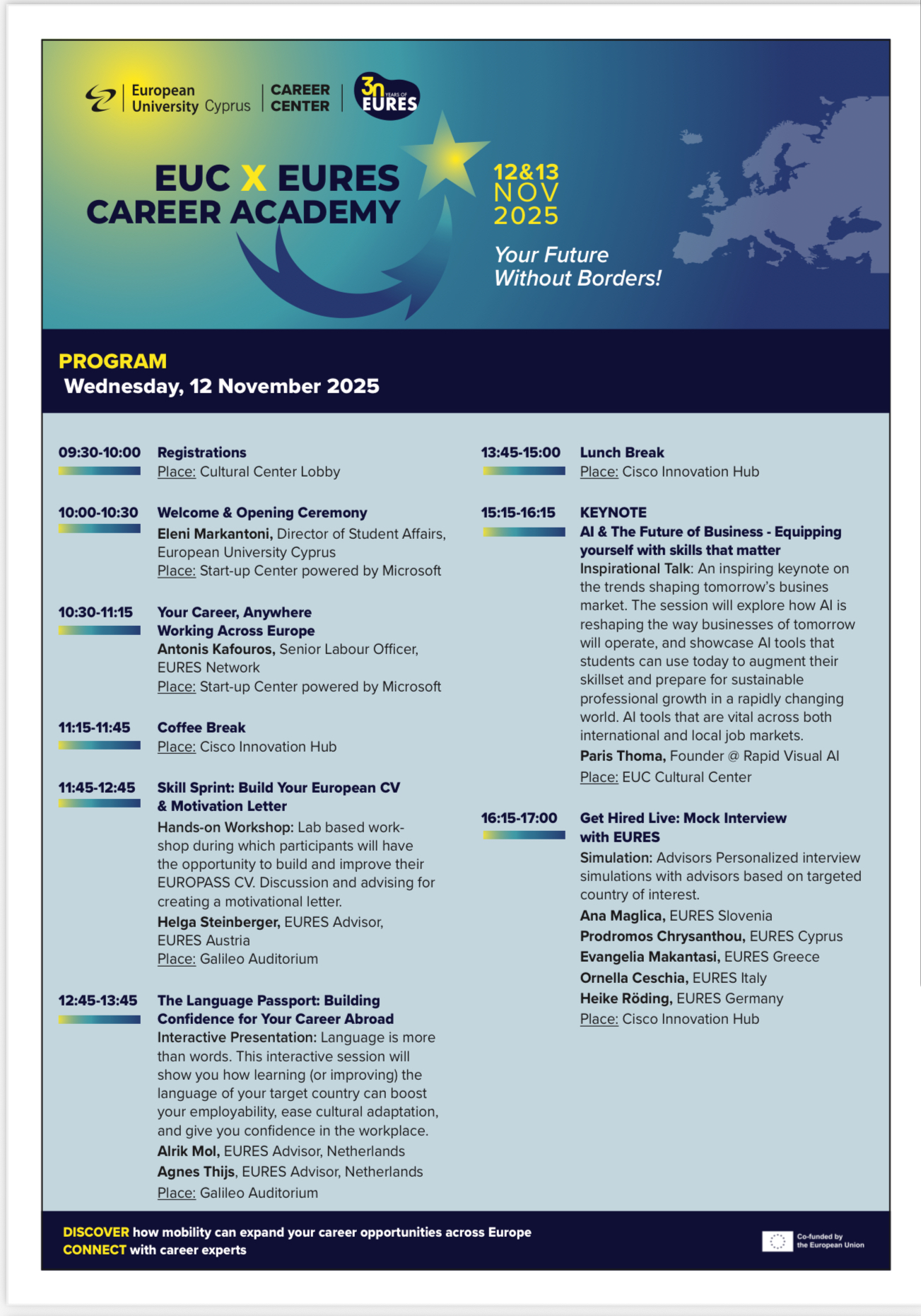
EURES CAREER ACADEMY- A collaboration between EURES CY and the European University Cyprus

EURES CAREER ACADEMY- A collaboration between EURES CY and the European University Cyprus

Kind:
Event
Start Date:
12 Nov 2025
End Date:
04 Jun 2026
Event Location:
Nicosia, Cyprus
EventType:
Language:

English

Slug
english
Identifier
skpEng
Language Version:
--
Sources:

Academic institutions

Research papers, synthesis reports, country and programme studies are collected from many academic institutions and national, regional and international professional associations.

Thumbnail
Identifier
skpAcaInst
Slug
academic-institutions

Governments

Governments hold a wealth of knowledge on skills development, and are increasingly realizing the value of learning from each others’ experiences. Their policy documents, programme evaluations, and research findings contain their experience and ideas on how to better link skills to employment

Thumbnail
Identifier
skpGov
Slug
governments
Topics:

Anticipating and matching skills needs

Thumbnail

Anticipating and building skills for the future is essential to a rapidly changing labour market. This applies to changes in the types and levels of skills needed as well as in occupational and technical areas. Effective methods to anticipate future skills needs and avoid potential mismatches include: sustained dialogue between employers and trainers, coordination across government institutions, labour market information systems, employment services and performance reviews of training institutions. 

Identifier
skpAFSN
Slug
anticipating-and-matching-skills-needs

Career guidance and employment services

Thumbnail

Career guidance and counselling, career education and lifelong development of skills for employability are key for success in learning activities, effective career transitions, livelihood planning, entrepreneurship and in increasing labour market participation. They are instrumental in promoting skills utilization, recognition (RPL), as well as in improving enterprise human resource management.

Career development activities encompass a wide variety of support activities including career information and advice, counselling, work exposure (e.g. job shadowing, work experience periods), assessment, coaching, mentoring, professional networking, advocacy, basic and employability skills training (curricular and non-curricular) and entrepreneurship training. It is often an area which is fragmented across different ministries (e.g. education, TVET, employment, youth) requiring an effort to achieve the necessary coordination to provide adequate support to individuals during learning, employment and unemployment/inactivity periods.
 

Identifier
skpLMIES
Slug
career-guidance-and-employment-services

Digital skills

Thumbnail

The world of work is undergoing a substantial transformation due to new forces. In particular, technological advances, such as AI, automation and robotics, have produced numerous new opportunities, but also given rise to urgent challenges. While new jobs are constantly being created with the emergence of the digital economy, many jobs are at risk of becoming obsolete. Digital innovations will rapidly change the demand for skills, thereby creating a wider skills gap that has the potential to hold back economic growth. Equipping people with basic or advanced digital skills promises to prepare them for unprecedented job opportunities in the digital economy. This will lead to innovation, higher productivity and competitiveness, as well as expanding markets, access to work and entrepreneurship opportunities. 

Identifier
skpdigskills
Slug
digital-skills

Youth employability

Thumbnail

Globally, nearly 68 million young women and men are looking for and available for work,  and an estimated 123 million young people are working but living in poverty. The number who are not in employment, education or training (NEET) stands at 267 million, a majority of whom are young women. Significantly, young people are three times as likely as adults (25 years and older) to be unemployed.

Skills development is a primary means of enabling young people to make a smooth transition to work. A comprehensive approach is required to integrate young women and men in the labour market, including relevant and quality skills training, labour market information, career guidance and employment services, recognition of prior learning, incorporating entrepreneurship with training and effective skills forecasting. Improved basic education and core work skills are particularly important to enable youth to engage in lifelong learning as well as transition to the labour market. 

Identifier
skpYoEmp
Slug
youth-employability
Knowledge Products:

Discover how mobility can shape, change or help your Career prospects. Connect with experts in the field to learn how mobility in the EU may elevate your skills.

Time: 12-13 November 2025 at 09:30-17.00

Place: The European University, Nicosia, Cyprus


Subject Tags:
Regions:
Countries and territories:
Economic groups:
--

Joining the DOTS between surviving and thriving, through skills recognition in the sciences within Higher Education

Joining the DOTS between surviving and thriving, through skills recognition in the sciences within Higher Education

Kind:
Event
Start Date:
03 Nov 2025
End Date:
04 Jun 2026
Event Location:
Online
EventType:
Language:

English

Slug
english
Identifier
skpEng
Language Version:
--
Sources:

Other sources

Experts from many international, regional and national agencies generously share their views, experiences and findings on skills, helping policy-makers among other stakeholders to understand the linkages between education, training and the world of work, and how to integrate skills into national development planning to promote employment and economic growth.

Thumbnail
Identifier
skpOSource
Slug
other-sources

Think tanks, foundations and consultancy services

The platform also contains information and resources developed by Think tanks, foundations and consultancy services.

Thumbnail
Identifier
skpttfcs
Slug
think-tanks-foundations-and-consultancy-services
Topics:

Anticipating and matching skills needs

Thumbnail

Anticipating and building skills for the future is essential to a rapidly changing labour market. This applies to changes in the types and levels of skills needed as well as in occupational and technical areas. Effective methods to anticipate future skills needs and avoid potential mismatches include: sustained dialogue between employers and trainers, coordination across government institutions, labour market information systems, employment services and performance reviews of training institutions. 

Identifier
skpAFSN
Slug
anticipating-and-matching-skills-needs

Recognition and portability of skills

Thumbnail

Skills development can be viewed from a life-cycle perspective of building, maintaining and improving competencies and skills. A holistic approach to skills development encompasses the following features: access to good basic education; development of cognitive and core skills, including literacy, numeracy, communication, problem-solving and learning ability; and, availability of continuous training opportunities targeting adult and older workers.  Systems to improve recognition of attained skills across occupations, industries and countries improve the employability of workers, reduce labour shortages, and promote good working conditions for migrant workers. 

Identifier
skpRAPS
Slug
recognition-and-portability-of-skills

Skills for transition to formality

Thumbnail

Most young people around the world do not have the chance to attend formal institutions of learning. The capacity of formal education and training systems is often limited due to inadequate training infrastructures and the relatively high costs of full-time, centre-based training. Consequently, large numbers of youth are learning and then working in the informal economy. 

Informal apprenticeship systems that transmit the skills of a trade to a young person in a micro- or small enterprise have operated for generations in many countries. They are considered by far the most important source of skills training in Africa and South Asia.

Women and men in the informal economy often do not possess a formal proof of their skills. Skills acquired informally are not visible and hence are often not recognized by employers. Transitions to the formal labour market can also be facilitated if skills are assessed and recognized. Systems of Recognition of Prior Learning are being introduced by countries to offer access to further learning or to formal labour markets.

Identifier
skpTrnForm
Slug
skills-for-transition-to-formality
Knowledge Products:

“Universities that prioritise human-centred capabilities, alongside technical skills, can prepare graduates for a changing job market and careers that complement rather than compete with AI.” Richard Brown, Associate Fellow at the University of London in a new report, HUMAN-CENTRIC: artificial intelligence, professional services and higher education, October 2025.

Also recognising the need to meet students where they are at and the growing pressures to work to support their university studies, join us for an online session that discusses a new employability initiative at Murdoch University in Australia that aims to support undergraduate students skills-based professional identity development for current and future employability. Hear from Professor of Immunology, Dr Cassandra Berry and Jane Foster, a careers practitioner working in the third space, who, together are supporting students to both recognise and articulate their growing laboratory skill-set and career competencies throughout their university experience, increasing agency and confidence in students’ professional selves for career readiness. The session is targeted to professionals working in Higher Education with expertise in career or science education.

The event is organised by National Association of Graduate Career Advisory Services (NAGCAS) - Australia’s peak professional body for career development in the higher and tertiary education sector. NAGCAS has membership in both Australia and New Zealand. Event is free for all members but also open to anyone (globally) at a fee of $25 AU.

Time: 3 November 2025 at 2.00pm-3.00pm (AEDT) Australian Eastern Daylight Time

More information: https://www.nagcas.org.au/events/event/joining-the-dots-between-surviving-and-thriving-through-skills-recognition-in-the-sciences


Subject Tags:
Regions:
Countries and territories:
Economic groups:
--

Euroguidance European Conference: Sustaining guidance within the Union of Skills (regional)

Euroguidance European Conference: Sustaining guidance within the Union of Skills (regional)

Kind:
Event
Start Date:
02 Dec 2025
End Date:
04 Jun 2026
Event Location:
Riga, Latvia and online
EventType:
Language:

English

Slug
english
Identifier
skpEng
Language Version:
--
Sources:

Governments

Governments hold a wealth of knowledge on skills development, and are increasingly realizing the value of learning from each others’ experiences. Their policy documents, programme evaluations, and research findings contain their experience and ideas on how to better link skills to employment

Thumbnail
Identifier
skpGov
Slug
governments
Topics:

Anticipating and matching skills needs

Thumbnail

Anticipating and building skills for the future is essential to a rapidly changing labour market. This applies to changes in the types and levels of skills needed as well as in occupational and technical areas. Effective methods to anticipate future skills needs and avoid potential mismatches include: sustained dialogue between employers and trainers, coordination across government institutions, labour market information systems, employment services and performance reviews of training institutions. 

Identifier
skpAFSN
Slug
anticipating-and-matching-skills-needs

Career guidance and employment services

Thumbnail

Career guidance and counselling, career education and lifelong development of skills for employability are key for success in learning activities, effective career transitions, livelihood planning, entrepreneurship and in increasing labour market participation. They are instrumental in promoting skills utilization, recognition (RPL), as well as in improving enterprise human resource management.

Career development activities encompass a wide variety of support activities including career information and advice, counselling, work exposure (e.g. job shadowing, work experience periods), assessment, coaching, mentoring, professional networking, advocacy, basic and employability skills training (curricular and non-curricular) and entrepreneurship training. It is often an area which is fragmented across different ministries (e.g. education, TVET, employment, youth) requiring an effort to achieve the necessary coordination to provide adequate support to individuals during learning, employment and unemployment/inactivity periods.
 

Identifier
skpLMIES
Slug
career-guidance-and-employment-services

Recognition and portability of skills

Thumbnail

Skills development can be viewed from a life-cycle perspective of building, maintaining and improving competencies and skills. A holistic approach to skills development encompasses the following features: access to good basic education; development of cognitive and core skills, including literacy, numeracy, communication, problem-solving and learning ability; and, availability of continuous training opportunities targeting adult and older workers.  Systems to improve recognition of attained skills across occupations, industries and countries improve the employability of workers, reduce labour shortages, and promote good working conditions for migrant workers. 

Identifier
skpRAPS
Slug
recognition-and-portability-of-skills

Skills for green transition/climate action

Thumbnail

The growing importance of sustainable development and the shift to a low-carbon and climateresilient economy will require new skills and qualifications, offering great potential for the creation of green jobs but also implying structural changes and a transformation of existing jobs. The transition to a low-carbon and greener economy will generate millions of new jobs, negatively affect some high-emitting sectors, and alter most existing occupations in terms of task compositions and skills requirements. 

Ensuring the right skills for green jobs is a prerequisite to make the transition to a greener economy happen. Today, skills gaps are already recognised as a major bottleneck in a number of sectors, such as renewable energy, energy and resource efficiency, green building or environmental services. The adoption and dissemination of clean technologies require skills in technology application, adaptation and maintenance. Skills are also crucial for economies and
businesses, workers and entrepreneurs to rapidly adapt to changes deriving from climate change and environmental policies. 

Identifier
skpGreen
Slug
skills-for-green-transition-climate-action
Knowledge Products:

Guidance practitioners, trainers, researchers and policy makers in the field of career guidance are welcome to join us at the Euroguidance European conference in Riga, Latvia on December 2-3, 2025. This flagship event for Europe in the Global Careers Month calendar focuses on "Sustaining Guidance within the Union of Skills."

Explore the vital link between career guidance, skills, and sustainability. The program offers a breadth of experiences, with two keynotes, ten workshops, twelve papers, and a panel discussion featuring diverse perspectives from practice, research, policy, education, and industry.

You'll also have a chance to connect with peers and enjoy Riga's rich culture with a guided visit to the Old Town or the Latvian National Library and a lively dinner with traditional folk music and dancing. 

Can't make it in person? Selected sessions will be streamed live and recorded for one year for all registered attendees.

The event is aimed at the European guidance community, but on-line attendance is available globally.

Time: 2 December 2025 at 09:00-21:00 and 3 December 2025 at 09:30-16:00 EET

Location: Radisson Blu Daugava, Kuģu iela 24,  Riga, Latvia. Online participation link will be sent to registered participants'

More information: https://sites.google.com/view/euroguidance2025gcm/home


Subject Tags:
Regions:
Countries and territories:
Economic groups:
--

Käänteentekevää kohtaantoa -hybriditilaisuus

Käänteentekevää kohtaantoa -hybriditilaisuus

Kind:
Event
Start Date:
30 Oct 2025
End Date:
04 Jun 2026
Event Location:
Oulu, Finland & online
EventType:
Language:

Finnish

Slug
finnish
Identifier
skpfin
Language Version:
--
Sources:

Other sources

Experts from many international, regional and national agencies generously share their views, experiences and findings on skills, helping policy-makers among other stakeholders to understand the linkages between education, training and the world of work, and how to integrate skills into national development planning to promote employment and economic growth.

Thumbnail
Identifier
skpOSource
Slug
other-sources

Think tanks, foundations and consultancy services

The platform also contains information and resources developed by Think tanks, foundations and consultancy services.

Thumbnail
Identifier
skpttfcs
Slug
think-tanks-foundations-and-consultancy-services
Topics:

Anticipating and matching skills needs

Thumbnail

Anticipating and building skills for the future is essential to a rapidly changing labour market. This applies to changes in the types and levels of skills needed as well as in occupational and technical areas. Effective methods to anticipate future skills needs and avoid potential mismatches include: sustained dialogue between employers and trainers, coordination across government institutions, labour market information systems, employment services and performance reviews of training institutions. 

Identifier
skpAFSN
Slug
anticipating-and-matching-skills-needs

Career guidance and employment services

Thumbnail

Career guidance and counselling, career education and lifelong development of skills for employability are key for success in learning activities, effective career transitions, livelihood planning, entrepreneurship and in increasing labour market participation. They are instrumental in promoting skills utilization, recognition (RPL), as well as in improving enterprise human resource management.

Career development activities encompass a wide variety of support activities including career information and advice, counselling, work exposure (e.g. job shadowing, work experience periods), assessment, coaching, mentoring, professional networking, advocacy, basic and employability skills training (curricular and non-curricular) and entrepreneurship training. It is often an area which is fragmented across different ministries (e.g. education, TVET, employment, youth) requiring an effort to achieve the necessary coordination to provide adequate support to individuals during learning, employment and unemployment/inactivity periods.
 

Identifier
skpLMIES
Slug
career-guidance-and-employment-services

Work-based learning and skills utilization

Thumbnail

Increasingly, countries around the world, at all levels of development are putting work-based learning, particularly apprenticeships, high on their policy agenda, recognizing its potential for reducing skills mismatch, meeting skills demand of a fast changing labour market, providing cost-effective training, promoting private sector development and smoothing transitions to the world of work. 

Moreover, the issue of how skills are used in the workplace and how businesses engage with the local skills ecosystem are getting greater attention. It is increasingly recognized that workers who better use their skills are more likely to have greater job satisfaction, earn better wages and are more prepared to adapt to changes in the nature of work, while employers benefit from a more productive and innovative workforce, enabling them to maximise business performance and profitability. 

Identifier
skpWrkLrn
Slug
work-based-learning-and-skills-utilization
Knowledge Products:

Results dissemination seminar for the Finnish Käänteentekevää kohtaantoa -project on employer co-operation and skills mismatch

Kohtaantoa-hanke on lähes kolmivuotisen taipaleensa aikana ollut mukana rakentamassa uudenlaista työnantajayhteistyötä ja luomassa käänteentekevää työtä työmarkkinoiden kohtaanto-ongelman ratkaisemiseksi. Nyt on aika esitellä, mitä olemme saaneet aikaan, millaisia työkaluja ja -malleja olemme kehittäneet, ja mihin suuntaan työnantajatyön kompassi osoittaa!  

Käänteentekevää kohtaantoa -hybriditilaisuudessa kuulemme hankkeen tavoitteista, tehdystä työstä sekä tuloksista. Mukana myös havaintoja työnantajatyöhön liittyvästä opinnäytetyöstä, joka korostaa työnantajatyön tärkeyttä palvelujärjestelmässä.

Vaikuttava asiakastarina kertoo työnhakijan ja työnantajan kohtaamisesta sekä työnantajatyön merkityksestä. Lisäksi Vates-säätiön erityisasiantuntija Kaija Ray tuo esiin ajankohtaisia näkökulmia työnantajayhteistyön haasteisiin ja ratkaisuihin.  

Aika: 30.10. klo 12–15
Paikka: Lasaretti, Aurora-sali, Kasarmintie 13 B, Oulu. Osallistuminen on mahdollista myös etänä.
Kieli: Suomi
Lisätietoa: https://nuortenystavat.fi/tapahtumat/kaanteentekevaa_kohtaantoa/

Subject Tags:
Regions:
Countries and territories:
Economic groups:
--