Anticipating and matching skills needs

Thumbnail

Anticipating and building skills for the future is essential to a rapidly changing labour market. This applies to changes in the types and levels of skills needed as well as in occupational and technical areas. Effective methods to anticipate future skills needs and avoid potential mismatches include: sustained dialogue between employers and trainers, coordination across government institutions, labour market information systems, employment services and performance reviews of training institutions. 

Identifier
skpAFSN
Slug
anticipating-and-matching-skills-needs

Salon virtuel des compétences : Coopération sud-sud et triangulaire

Salon virtuel des compétences : Coopération sud-sud et triangulaire

Kind:
Event
Start Date:
21 Apr 2021
End Date:
17 Jun 2026
Event Location:
Virtual event
EventType:
Language:

French

Slug
french
Identifier
skpFrn
Language Version:
--
Sources:

ILO

The International Labour Organization is the tripartite U.N. agency that promotes Decent Work through employment, social security, labour standards and social dialogue. Its work on skills development is guided by the conceptual framework on Skills to improve productivity, employment growth, and development agreed in 2008 by representatives of Governments, Employers’ Associations and Workers’ Associations. Research, policy advice, and pilot projects and technical cooperation programmes to apply good practices in different circumstances across its 185 member States aims to boost the employability of workers, the productivity and competitiveness of enterprises, and the inclusiveness of economic growth. The ILO Secretariat in offices in 40 countries works with Ministries of Labour, employers’ organizations, and trade unions to integrate skills development into national and sector development strategies in order to better meet current labour market needs and to prepare for the jobs of the future; to expand access to employment-related training so that youth, persons with disabilities and other vulnerable groups are better able to acquire skills and secure productive and decent work; and to improve the ability of public employment services to provide career guidance, maintain labour exchange services, and deliver active labour market programmes.For more information regarding the ILO’s work on skills and employability go to: http://www.ilo.org/skills/lang--en/index.htm; for ILO/Cinterfor's Knowledge Management Plarform, see: http://www.oitcinterfor.org

Thumbnail
Identifier
skpILO
Slug
ilo
Topics:

Anticipating and matching skills needs

Thumbnail

Anticipating and building skills for the future is essential to a rapidly changing labour market. This applies to changes in the types and levels of skills needed as well as in occupational and technical areas. Effective methods to anticipate future skills needs and avoid potential mismatches include: sustained dialogue between employers and trainers, coordination across government institutions, labour market information systems, employment services and performance reviews of training institutions. 

Identifier
skpAFSN
Slug
anticipating-and-matching-skills-needs
Knowledge Products:

Other knowledge products

Thumbnail
Identifier
skpOProduct
Slug
other-knowledge-products

Une série de webinaires a été organisée en 2020, webinaires axés sur les domaines thématiques du développement des compétences et sur les approches sectorielles.

Ce salon vise à favoriser le développement des capacités humaines dans les pays en développement en mettant l'accent sur le développement des compétences, en renforçant la capacité des pays à trouver des solutions aux besoins spécifiques de développement et aux défis désormais exacerbés par la pandémie de COVID-19. En outre, il vise à :
- promouvoir et renforcer l'échange d'expériences;
- encourager la mise en commun, le partage et l'utilisation des ressources techniques et autres;
- soutenir l'identification du potentiel de partenariat des pays et institutions participants. Il répond aux domaines thématiques et/ou sectoriels prioritaires proposés pour le soutien de l'OIT à la coopération Sud-Sud.

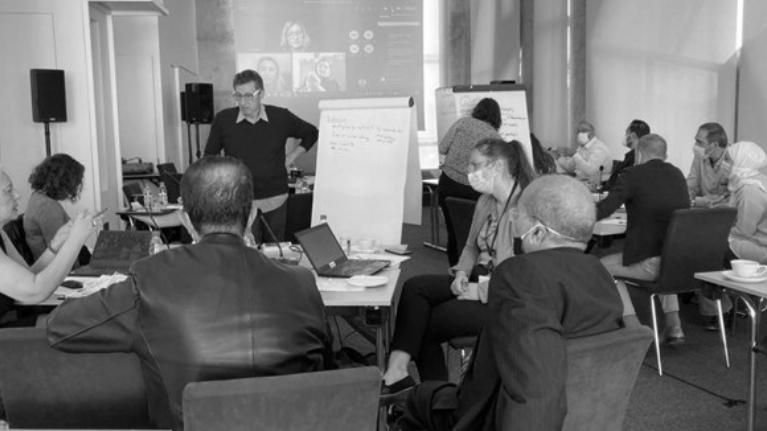
Compte tenu des restrictions de voyage et de réunion liées à la pandémie COVID-19, le forum prendra la forme d'un Salon virtuel qui utilisera la réalité augmentée (RA).

Les mandants tripartites d'environ 35 pays du Sud seront invités à participer. Les participants:
- seront invités à présenter des bonnes pratiques et bénéficieront d'un soutien pour développer des stands virtuels
- auront la possibilité d'assister à des conférences de haut niveau sur des sujets choisis
- seront invités à présenter leurs bonnes pratiques dans le cadre de session(s) consacrée(s) à l'agriculture où nous aborderons l'avenir du travail dans le secteur
- participeront à des réunions sur des sujets et secteurs clés de l'E-Fora CSST et compétences
- seront invités à identifier d'autres institutions pour négocier et discuter des possibilités de partenariat, avec l'aide de l'OIT.

Pour en savoir plus, cliquez sur lien ci-dessous.

 

Subject Tags:

Skills upgrading

Slug
skills-upgrading
Identifier
657
Regions:
Countries and territories:
Economic groups:
--

Skills Virtual Fair: South-south and triangular cooperation

Skills Virtual Fair: South-south and triangular cooperation

Kind:
Event
Start Date:
21 Apr 2021
End Date:
17 Jun 2026
Event Location:
Virtual event
EventType:
Language:

English

Slug
english
Identifier
skpEng
Language Version:
--
Sources:

ILO

The International Labour Organization is the tripartite U.N. agency that promotes Decent Work through employment, social security, labour standards and social dialogue. Its work on skills development is guided by the conceptual framework on Skills to improve productivity, employment growth, and development agreed in 2008 by representatives of Governments, Employers’ Associations and Workers’ Associations. Research, policy advice, and pilot projects and technical cooperation programmes to apply good practices in different circumstances across its 185 member States aims to boost the employability of workers, the productivity and competitiveness of enterprises, and the inclusiveness of economic growth. The ILO Secretariat in offices in 40 countries works with Ministries of Labour, employers’ organizations, and trade unions to integrate skills development into national and sector development strategies in order to better meet current labour market needs and to prepare for the jobs of the future; to expand access to employment-related training so that youth, persons with disabilities and other vulnerable groups are better able to acquire skills and secure productive and decent work; and to improve the ability of public employment services to provide career guidance, maintain labour exchange services, and deliver active labour market programmes.For more information regarding the ILO’s work on skills and employability go to: http://www.ilo.org/skills/lang--en/index.htm; for ILO/Cinterfor's Knowledge Management Plarform, see: http://www.oitcinterfor.org

Thumbnail
Identifier
skpILO
Slug
ilo
Topics:

Anticipating and matching skills needs

Thumbnail

Anticipating and building skills for the future is essential to a rapidly changing labour market. This applies to changes in the types and levels of skills needed as well as in occupational and technical areas. Effective methods to anticipate future skills needs and avoid potential mismatches include: sustained dialogue between employers and trainers, coordination across government institutions, labour market information systems, employment services and performance reviews of training institutions. 

Identifier
skpAFSN
Slug
anticipating-and-matching-skills-needs
Knowledge Products:

Other knowledge products

Thumbnail
Identifier
skpOProduct
Slug
other-knowledge-products

A series of webinars were held in 2020 focussed on Skills Development thematic areas and on sectoral approaches.

This virtual fair aims to foster the development of human capabilities in developing countries with a focus on Skills Development, by enhancing countries’ capacity to find solutions to specific development needs and to the challenges now exacerbated by the COVID-19 pandemic. Moreover, It aims to:
- promote and strengthen the exchange of experiences;
- encourage the pooling, sharing and use of technical and other resources;
- supports the identification of participanting countries’ and institutions’ partnership potential. it responds to the proposed thematic & or sector priority areas for ILO’s support to South-South Cooperation.
Given the travel and meeting restrictions related to the COVID-19 pandemic, the forum will take the form of a Virtual Fair that will used Augmented Reality (AR).

Tripartite constituents from around 35 countries from the Global South will be invited to participate. Participants:
- will be invited to present good practices and will be supported to develop virtual booths
- will have the opportunity to attend High level conferences on selected topics
- are invited to present their good practices in dedicated session(s) on Agriculture where we will touch upon the Future of Work in the sector
- will participate on Meetings on SSTC SKILLS E-Fora key topics and sectors
are invited to identify other institutions to negotiate and discuss partnership possibilities, facilitated by the ILO.

To learn more, click on the link provided below.
 

Subject Tags:

Apprenticeships

Slug
apprenticeships
Identifier
639

Skilled workers

Slug
skilled-workers
Identifier
45

Youth employment

Slug
youth-employment
Identifier
15
Regions:
Countries and territories:
Economic groups:
--

Proporcionar las competencias adecuadas en el momento adecuado: El papel del desarrollo de competencias sectoriales para contribuir a economías más productivas y competitivas

Proporcionar las competencias adecuadas en el momento adecuado: El papel del desarrollo de competencias sectoriales para contribuir a economías más productivas y competitivas

Type:
Discussion
Start Date:
03 Oct 2016
End Date:
14 Oct 2016
Language:

Spanish

Slug
spanish
Identifier
skpEsp
Language Version:
--
Sources:

ILO

The International Labour Organization is the tripartite U.N. agency that promotes Decent Work through employment, social security, labour standards and social dialogue. Its work on skills development is guided by the conceptual framework on Skills to improve productivity, employment growth, and development agreed in 2008 by representatives of Governments, Employers’ Associations and Workers’ Associations. Research, policy advice, and pilot projects and technical cooperation programmes to apply good practices in different circumstances across its 185 member States aims to boost the employability of workers, the productivity and competitiveness of enterprises, and the inclusiveness of economic growth. The ILO Secretariat in offices in 40 countries works with Ministries of Labour, employers’ organizations, and trade unions to integrate skills development into national and sector development strategies in order to better meet current labour market needs and to prepare for the jobs of the future; to expand access to employment-related training so that youth, persons with disabilities and other vulnerable groups are better able to acquire skills and secure productive and decent work; and to improve the ability of public employment services to provide career guidance, maintain labour exchange services, and deliver active labour market programmes.For more information regarding the ILO’s work on skills and employability go to: http://www.ilo.org/skills/lang--en/index.htm; for ILO/Cinterfor's Knowledge Management Plarform, see: http://www.oitcinterfor.org

Thumbnail
Identifier
skpILO
Slug
ilo
Topics:

Anticipating and matching skills needs

Thumbnail

Anticipating and building skills for the future is essential to a rapidly changing labour market. This applies to changes in the types and levels of skills needed as well as in occupational and technical areas. Effective methods to anticipate future skills needs and avoid potential mismatches include: sustained dialogue between employers and trainers, coordination across government institutions, labour market information systems, employment services and performance reviews of training institutions. 

Identifier
skpAFSN
Slug
anticipating-and-matching-skills-needs

Sectoral approaches

Thumbnail

Matching skills to labour market demand requires reliable sectoral and occupational information and institutions that connect employers with training providers.  Sector based strategies and institutions have proved effective in engaging all stakeholders in promoting both pre-employment training and life-long learning.

Identifier
skpSectApr
Slug
sectoral-approaches
Knowledge Products:

Other knowledge products

Thumbnail
Identifier
skpOProduct
Slug
other-knowledge-products

Moderators


3 al 14 de octubre del 2016

Esta discusión permitirá a expertos, profesionales y representantes de varias instituciones y empresas en diferentes partes del mundo a unirse virtualmente para plantear preguntas, compartir experiencias y enfrentar desafíos sobre la implementación de enfoques sectoriales para el desarrollo de habilidades. La discusión será co-moderada por especialistas de la OIT, entre ellos: Cornelius Gregg and Bolormaa Tumurchudur-Klok. (La discusión funciona mejor cuando se accede desde los siguientes navegadores: Chrome o Firefox.)


Ayudar a las empresas a encontrar trabajadores con las competencias adecuadas, y garantizar que los trabajadores puedan adquirir esas competencias, es una llave hacia la prosperidad económica y la construcción de sociedades más inclusivas. Los enfoques sectoriales ayudan a ofrecer las competencias necesarias, basándose en la demanda y para la ventaja económica del país.

La PIC Global centrará esta E-Discusión en ‘Proporcionar las competencias adecuadas en el momento adecuado: El desarrollo de competencias sectoriales’. Durante la primera semana, la PIC Global revisará los retos actuales de la industria y el mercado laboral en materia de competencias. Durante la segunda semana, invitamos a los participantes a compartir sus experiencias y buenas prácticas acerca de la implementación de enfoques sectoriales para el de desarrollo de competencias.

Consulte la nota de orientación al final de la página.

Preguntas para la segunda semana: Iniciativas y lo que funciona:
- Los enfoques de desarrollo de competencias sectoriales han demostrado ser útiles para trabajar en conjunto con los empleadores, aunque toman diferentes formas dentro de diferentes contextos nacionales. ¿Qué modelos de compromiso por parte de los empleadores pueden ser identificados como eficaces para examinar enfoques para el desarrollo de competencias sectoriales?

- ¿Qué papel juegan los consejos sectoriales tripartitos para anticipar las necesidades de un sector para la formación de competencias actuales y futuras y la evaluación de la calidad y la pertinencia de los programas de formación?

- ¿Cuáles son algunos ejemplos de estrategias eficaces y con vista para el futuro para el desarrollo de competencias en un sector particular, para mejorar el rendimiento de las empresas y mantener vigentes las competencias de los trabajadores?

- ¿En qué medida consideran los países las necesidades específicas de sus sectores dominantes al desarrollar estrategias nacionales en materia de competencias y de ETP?

Subject Tags:

G20 Training Strategy

Slug
g20-training-strategy
Identifier
644

Private sector

Slug
private-sector
Identifier
229

Sectoral approaches

Slug
sectoral-approaches
Identifier
676

Skills anticipation

Slug
skills-anticipation
Identifier
677
Regions:
Countries and territories:
Economic groups:
--

Digital skills and the future of work: Challenges and opportunities in a post COVID-19 environment

Digital skills and the future of work: Challenges and opportunities in a post COVID-19 environment

Type:
Document
Content Type:
Digital skills and the future of work: Challenges and opportunities in a post COVID-19 environment
Language:

English

Slug
english
Identifier
skpEng
Sources:

ILO

The International Labour Organization is the tripartite U.N. agency that promotes Decent Work through employment, social security, labour standards and social dialogue. Its work on skills development is guided by the conceptual framework on Skills to improve productivity, employment growth, and development agreed in 2008 by representatives of Governments, Employers’ Associations and Workers’ Associations. Research, policy advice, and pilot projects and technical cooperation programmes to apply good practices in different circumstances across its 185 member States aims to boost the employability of workers, the productivity and competitiveness of enterprises, and the inclusiveness of economic growth. The ILO Secretariat in offices in 40 countries works with Ministries of Labour, employers’ organizations, and trade unions to integrate skills development into national and sector development strategies in order to better meet current labour market needs and to prepare for the jobs of the future; to expand access to employment-related training so that youth, persons with disabilities and other vulnerable groups are better able to acquire skills and secure productive and decent work; and to improve the ability of public employment services to provide career guidance, maintain labour exchange services, and deliver active labour market programmes.For more information regarding the ILO’s work on skills and employability go to: http://www.ilo.org/skills/lang--en/index.htm; for ILO/Cinterfor's Knowledge Management Plarform, see: http://www.oitcinterfor.org

Thumbnail
Identifier
skpILO
Slug
ilo

Other sources

Experts from many international, regional and national agencies generously share their views, experiences and findings on skills, helping policy-makers among other stakeholders to understand the linkages between education, training and the world of work, and how to integrate skills into national development planning to promote employment and economic growth.

Thumbnail
Identifier
skpOSource
Slug
other-sources
Topics:

Anticipating and matching skills needs

Thumbnail

Anticipating and building skills for the future is essential to a rapidly changing labour market. This applies to changes in the types and levels of skills needed as well as in occupational and technical areas. Effective methods to anticipate future skills needs and avoid potential mismatches include: sustained dialogue between employers and trainers, coordination across government institutions, labour market information systems, employment services and performance reviews of training institutions. 

Identifier
skpAFSN
Slug
anticipating-and-matching-skills-needs
Knowledge Products:

Other knowledge products

Thumbnail
Identifier
skpOProduct
Slug
other-knowledge-products
Publication Date:
05 Apr 2021
This note is based on the WISIS Forum 2020 session “Digital skills and the future of work: challenges and opportunities in a post COVID-19 environment” hosted by ITU. As the world is transforming towards a digital society, countries are urged to look at their labour demand to create appropriate job opportunities through adequate skills (and notably digital skills) and infrastructure. This note includes presentations made during the WISIS session on “Digital skills and the future of work: Challenges and opportunities in a post COVID-19 environment”, by representatives of ITU, ILO, Microsoft and E-Estonia.
Subject Tags:

Skills anticipation

Slug
skills-anticipation
Identifier
677
Regions:

REACH2025: Jordan’s Digital Economy Action Plan

REACH2025: Jordan’s Digital Economy Action Plan

Type:
Document
Content Type:
REACH2025: Jordan’s Digital Economy Action Plan
Language:

English

Slug
english
Identifier
skpEng
Sources:

Governments

Governments hold a wealth of knowledge on skills development, and are increasingly realizing the value of learning from each others’ experiences. Their policy documents, programme evaluations, and research findings contain their experience and ideas on how to better link skills to employment

Thumbnail
Identifier
skpGov
Slug
governments
Topics:

Anticipating and matching skills needs

Thumbnail

Anticipating and building skills for the future is essential to a rapidly changing labour market. This applies to changes in the types and levels of skills needed as well as in occupational and technical areas. Effective methods to anticipate future skills needs and avoid potential mismatches include: sustained dialogue between employers and trainers, coordination across government institutions, labour market information systems, employment services and performance reviews of training institutions. 

Identifier
skpAFSN
Slug
anticipating-and-matching-skills-needs
Knowledge Products:

Research papers

Working papers, reports, and other publications from international organizations, academic institutions and bilateral agencies. Research findings to stimulate informed debate on skills, employment and productivity issues. 

Thumbnail
Identifier
skpRPS
Slug
research-papers
Publication Date:
05 Apr 2021
The REACH2025 initiative is based on Jordan’s strengths and opportunities for responding to the current digital strengths and for making Jordan relevant in the global digital economy.

REACH2025 Vision is to have a digital economy that empowers people, sectors and businesses to raise productivity and ensure growth and prosperity, creating a highly attractive business destination for investments and international partnerships.

REACH2025 Mission: Jordan will Ensure a highly stable, nurturing business environment. Drive creative and innovative technologies in key niche sectors and markets. Strengthen the entrepreneurial mindset of the country, supported by specialized skills. Support the transformation towards being a platform for innovation in international partnerships. Spur innovation through open access in technology, people, standards and data.

REACH2025 action plan seeks to streamline the digital transformation across the entire Jordanian economy. With the plan, Jordan is moving away from seeing ICT as an isolated sector and towards digitizing the entire Jordanian economy with emphasis on niche markets and global value chains. This is about creating a transformation across the economy through digitization of early adopters in: Health, Energy and CleanTech, Education, Finance, Transport, Communications and Security.
Subject Tags:

Skills anticipation

Slug
skills-anticipation
Identifier
677
Regions:

Arab States

Region Image
Countries and territories:

Jordan Digital Transformation Strategy

Jordan Digital Transformation Strategy

Type:
Document
Content Type:
Jordan Digital Transformation Strategy
Language:

English

Slug
english
Identifier
skpEng
Sources:

Governments

Governments hold a wealth of knowledge on skills development, and are increasingly realizing the value of learning from each others’ experiences. Their policy documents, programme evaluations, and research findings contain their experience and ideas on how to better link skills to employment

Thumbnail
Identifier
skpGov
Slug
governments
Topics:

Anticipating and matching skills needs

Thumbnail

Anticipating and building skills for the future is essential to a rapidly changing labour market. This applies to changes in the types and levels of skills needed as well as in occupational and technical areas. Effective methods to anticipate future skills needs and avoid potential mismatches include: sustained dialogue between employers and trainers, coordination across government institutions, labour market information systems, employment services and performance reviews of training institutions. 

Identifier
skpAFSN
Slug
anticipating-and-matching-skills-needs
Knowledge Products:

Research papers

Working papers, reports, and other publications from international organizations, academic institutions and bilateral agencies. Research findings to stimulate informed debate on skills, employment and productivity issues. 

Thumbnail
Identifier
skpRPS
Slug
research-papers
Publication Date:
05 Apr 2021
The production process is witnessing unprecedented transformations as a result of the accelerated growth of digital technology, development of smart devices, machines, systems, and increased data processing and artificial intelligence capabilities. These developments and transformations led to revolutionary changes in the global economy.
Subject Tags:

Skills anticipation

Slug
skills-anticipation
Identifier
677
Regions:

Arab States

Region Image
Countries and territories:

Jordan Artificial Intelligence Policy

Jordan Artificial Intelligence Policy

Type:
Document
Content Type:
Jordan Artificial Intelligence Policy
Language:

English

Slug
english
Identifier
skpEng
Sources:

Governments

Governments hold a wealth of knowledge on skills development, and are increasingly realizing the value of learning from each others’ experiences. Their policy documents, programme evaluations, and research findings contain their experience and ideas on how to better link skills to employment

Thumbnail
Identifier
skpGov
Slug
governments
Topics:

Anticipating and matching skills needs

Thumbnail

Anticipating and building skills for the future is essential to a rapidly changing labour market. This applies to changes in the types and levels of skills needed as well as in occupational and technical areas. Effective methods to anticipate future skills needs and avoid potential mismatches include: sustained dialogue between employers and trainers, coordination across government institutions, labour market information systems, employment services and performance reviews of training institutions. 

Identifier
skpAFSN
Slug
anticipating-and-matching-skills-needs
Knowledge Products:

Research papers

Working papers, reports, and other publications from international organizations, academic institutions and bilateral agencies. Research findings to stimulate informed debate on skills, employment and productivity issues. 

Thumbnail
Identifier
skpRPS
Slug
research-papers
Publication Date:
05 Apr 2021
Government recognizes the leading role of Artificial Intelligence (AI) in the development of a sustainable digital-led economy. This is confirmed by the General Policy for the Information & Communication Technology and Postal Sectors 2018 in Article 8 which states: "This policy is intended to seize the opportunities of the Fourth Industrial Revolution with the primary goal being the development of a digital economy leading to renewed economic development and increased income and wealth of individual Jordanians. Government is keen for Jordan to harness existing and emerging digital technologies including but not limited to Artificial Intelligence, Blockchain and the Internet of Things (IoT) provided by the Telecommunications, Information Technology and Postal sectors for economic and social development."
Subject Tags:

Information and communication technologies

Slug
information-and-communication-technologies
Identifier
346

Skills anticipation

Slug
skills-anticipation
Identifier
677
Regions:

Arab States

Region Image
Countries and territories:

Supply and Demand Gap Analysis for Digital Skills in the ICT1 Industry

Supply and Demand Gap Analysis for Digital Skills in the ICT1 Industry

Type:
Document
Content Type:
Supply and Demand Gap Analysis for Digital Skills in the ICT1 Industry
Language:

English

Slug
english
Identifier
skpEng
Sources:

Governments

Governments hold a wealth of knowledge on skills development, and are increasingly realizing the value of learning from each others’ experiences. Their policy documents, programme evaluations, and research findings contain their experience and ideas on how to better link skills to employment

Thumbnail
Identifier
skpGov
Slug
governments
Topics:

Anticipating and matching skills needs

Thumbnail

Anticipating and building skills for the future is essential to a rapidly changing labour market. This applies to changes in the types and levels of skills needed as well as in occupational and technical areas. Effective methods to anticipate future skills needs and avoid potential mismatches include: sustained dialogue between employers and trainers, coordination across government institutions, labour market information systems, employment services and performance reviews of training institutions. 

Identifier
skpAFSN
Slug
anticipating-and-matching-skills-needs
Knowledge Products:

Research papers

Working papers, reports, and other publications from international organizations, academic institutions and bilateral agencies. Research findings to stimulate informed debate on skills, employment and productivity issues. 

Thumbnail
Identifier
skpRPS
Slug
research-papers
Publication Date:
05 Apr 2021
The Ministry of Digital Economy & Entrepreneurship (MoDEE), Jordan, is the implementing agency of the YTJ project and aims to improve digitally enabled income opportunities and expand digitized government services in Jordan. The YTJ project will build an impetus for private sector-led growth of the digital economy and make interventions to address specific constraints in the supply and demand sides of the economy.
Subject Tags:

Information and communication technologies

Slug
information-and-communication-technologies
Identifier
346

Skills anticipation

Slug
skills-anticipation
Identifier
677
Regions:

Arab States

Region Image
Countries and territories:

Skills and jobs in the internet economy

Skills and jobs in the internet economy

Type:
Document
Content Type:
Skills and jobs in the internet economy
Language:

English

Slug
english
Identifier
skpEng
Sources:

Information is gathered from other international organizations that promote skills development and the transition from education and training to work. The Interagency Group on Technical and Vocational Education and Training (IAG-TVET) was established in 2009 to share research findings, coordinate joint research endeavours, and improve collaboration among organizations working at the international and national levels.

Thumbnail
Identifier
skpIntOrg
Slug
international-organizations
Topics:

Anticipating and matching skills needs

Thumbnail

Anticipating and building skills for the future is essential to a rapidly changing labour market. This applies to changes in the types and levels of skills needed as well as in occupational and technical areas. Effective methods to anticipate future skills needs and avoid potential mismatches include: sustained dialogue between employers and trainers, coordination across government institutions, labour market information systems, employment services and performance reviews of training institutions. 

Identifier
skpAFSN
Slug
anticipating-and-matching-skills-needs
Knowledge Products:

Research papers

Working papers, reports, and other publications from international organizations, academic institutions and bilateral agencies. Research findings to stimulate informed debate on skills, employment and productivity issues. 

Thumbnail
Identifier
skpRPS
Slug
research-papers
Publication Date:
05 Apr 2021
The combination of slow economic growth, lingering unemployment, some of it structural, and a dramatic demographic shift towards older populations on the horizon is increasing pressure on policy makers to find ways to boost productivity. The Internet is seen as a key platform that can help support needed productivity gains, open up new business opportunities, and lead to new and better jobs. But at the same time, the Internet is forcing a significant reorganisation of businesses, and this affects labour demand and ultimately employment. The combined effect of these drivers is not obvious, and may depend on specific conditions and policies in each country.
Subject Tags:
Regions:

Infographic: Skills development in the time of COVID-19: Taking stock of the initial responses in technical and vocational education and training

Infographic: Skills development in the time of COVID-19: Taking stock of the initial responses in technical and vocational education and training

Type:
Document
Content Type:
Infographic: Skills development in the time of COVID-19: Taking stock of the initial responses in technical and vocational education and training
Language:

English

Slug
english
Identifier
skpEng
Sources:

ILO

The International Labour Organization is the tripartite U.N. agency that promotes Decent Work through employment, social security, labour standards and social dialogue. Its work on skills development is guided by the conceptual framework on Skills to improve productivity, employment growth, and development agreed in 2008 by representatives of Governments, Employers’ Associations and Workers’ Associations. Research, policy advice, and pilot projects and technical cooperation programmes to apply good practices in different circumstances across its 185 member States aims to boost the employability of workers, the productivity and competitiveness of enterprises, and the inclusiveness of economic growth. The ILO Secretariat in offices in 40 countries works with Ministries of Labour, employers’ organizations, and trade unions to integrate skills development into national and sector development strategies in order to better meet current labour market needs and to prepare for the jobs of the future; to expand access to employment-related training so that youth, persons with disabilities and other vulnerable groups are better able to acquire skills and secure productive and decent work; and to improve the ability of public employment services to provide career guidance, maintain labour exchange services, and deliver active labour market programmes.For more information regarding the ILO’s work on skills and employability go to: http://www.ilo.org/skills/lang--en/index.htm; for ILO/Cinterfor's Knowledge Management Plarform, see: http://www.oitcinterfor.org

Thumbnail
Identifier
skpILO
Slug
ilo
Topics:

Anticipating and matching skills needs

Thumbnail

Anticipating and building skills for the future is essential to a rapidly changing labour market. This applies to changes in the types and levels of skills needed as well as in occupational and technical areas. Effective methods to anticipate future skills needs and avoid potential mismatches include: sustained dialogue between employers and trainers, coordination across government institutions, labour market information systems, employment services and performance reviews of training institutions. 

Identifier
skpAFSN
Slug
anticipating-and-matching-skills-needs
Knowledge Products:

Other knowledge products

Thumbnail
Identifier
skpOProduct
Slug
other-knowledge-products
Publication Date:
05 Apr 2021

This report is based on the findings of an interagency survey on technical and vocational education and training (TVET) and skills development in the time of COVID-19. The online survey, which was targeted at TVET providers, policymakers and social partners, was implemented by the ILO in collaboration with the UNESCO and the World Bank over the period from 5 April to 15 May 2020.

Subject Tags:
Regions: