Regional Knowledge Sharing Workshop on Trade and Skills
Regional Knowledge Sharing Workshop on Trade and Skills
English
ILO
The International Labour Organization is the tripartite U.N. agency that promotes Decent Work through employment, social security, labour standards and social dialogue. Its work on skills development is guided by the conceptual framework on Skills to improve productivity, employment growth, and development agreed in 2008 by representatives of Governments, Employers’ Associations and Workers’ Associations. Research, policy advice, and pilot projects and technical cooperation programmes to apply good practices in different circumstances across its 185 member States aims to boost the employability of workers, the productivity and competitiveness of enterprises, and the inclusiveness of economic growth. The ILO Secretariat in offices in 40 countries works with Ministries of Labour, employers’ organizations, and trade unions to integrate skills development into national and sector development strategies in order to better meet current labour market needs and to prepare for the jobs of the future; to expand access to employment-related training so that youth, persons with disabilities and other vulnerable groups are better able to acquire skills and secure productive and decent work; and to improve the ability of public employment services to provide career guidance, maintain labour exchange services, and deliver active labour market programmes.For more information regarding the ILO’s work on skills and employability go to: http://www.ilo.org/skills/lang--en/index.htm; for ILO/Cinterfor's Knowledge Management Plarform, see: http://www.oitcinterfor.org

Other sources
Experts from many international, regional and national agencies generously share their views, experiences and findings on skills, helping policy-makers among other stakeholders to understand the linkages between education, training and the world of work, and how to integrate skills into national development planning to promote employment and economic growth.

Anticipating and matching skills needs

Anticipating and building skills for the future is essential to a rapidly changing labour market. This applies to changes in the types and levels of skills needed as well as in occupational and technical areas. Effective methods to anticipate future skills needs and avoid potential mismatches include: sustained dialogue between employers and trainers, coordination across government institutions, labour market information systems, employment services and performance reviews of training institutions.
Sectoral approaches

Matching skills to labour market demand requires reliable sectoral and occupational information and institutions that connect employers with training providers. Sector based strategies and institutions have proved effective in engaging all stakeholders in promoting both pre-employment training and life-long learning.
Skills policies and strategies

Skills and employment policies should be viewed together. The full value of one policy set is realized when it supports the objectives of the other. For investments in education and training to yield maximum benefit to workers, enterprises, and economies, countries’ capacities for coordination is critical in three areas: connecting basic education to technical training and then to market entry; ensuring continuous communication between employers and training providers so that training meets the needs and aspirations of workers and enterprises, and integrating skills development policies with industrial, investment, trade, technology, environmental, rural and local development policies.
Organised within the framework of the “Aid for Trade for the Arab States” multi-agency initiative
In many countries of the Arab region, the relatively low level of economic diversification contributes to continued dependence on a handful of commodities, particularly oil, gas and minerals as main exports, along with exports in some labour-intensive manufacturing sectors. Lack of diversification in traded products, and in trading partners, results in over-dependence on these sectors, where opportunities for growth of productive and higher-value employment are scarce. Unemployment and under-employment results from insufficient economic growth, and also from poor alignment between education and training, and future labour market needs respectively. Incidentally, the Arab region has the highest youth unemployment rate in the world. Creating an enabling environment for new investment and job growth requires a well-trained workforce, able to continue learning and adapting to new technologies and work organization.
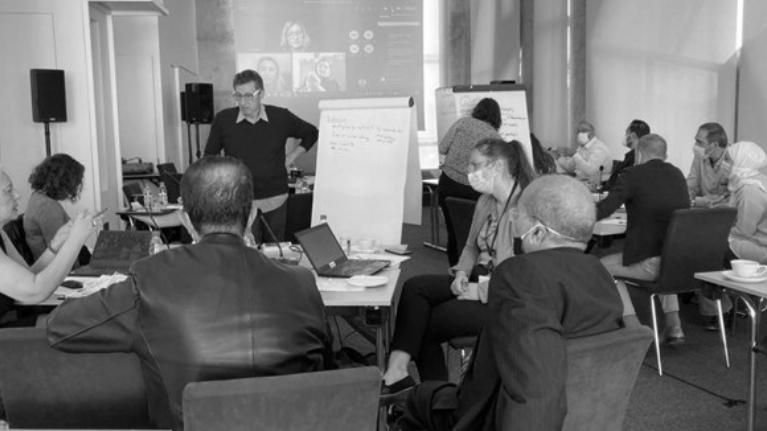
This Workshop provides an opportunity to share knowledge about whether skill gaps constrain trade growth in specific sectors and to share experiences on how to overcome such constraints as part of comprehensive trade promotion strategies. It will facilitate an overview of the Aid for Trade initiative; shared views from the ILO, the World Trade Organization, governments, employers and workers on skills for more and better jobs from trade; reviews of initial experiences in Egypt and Jordan in the ILO’s programme on Skills for Trade and Economic Diversification (STED); and discussions on regional prospects for integrating skills in trade policies to accelerate trade and to ensure a widespread sharing of the benefits of trade growth.
Policy convergence
Sectoral approaches
Arab States